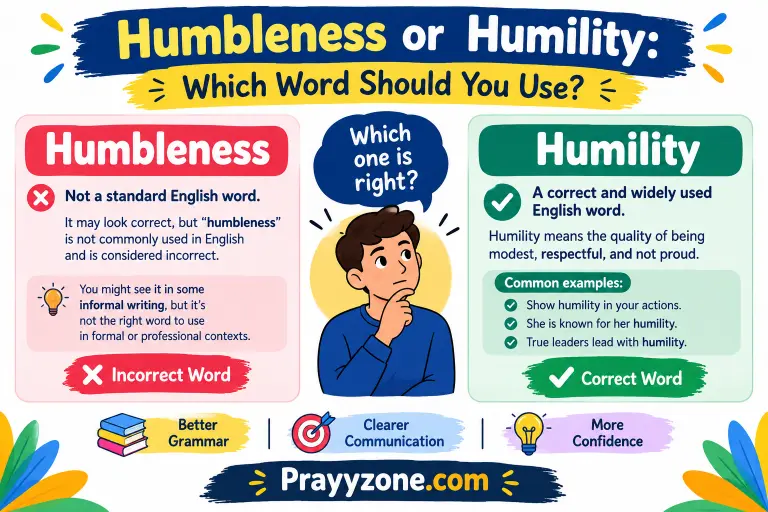
”Humbleness and humility are both correct words that describe the quality of being humble. Humility is more common and generally preferred in formal or polished writing, while humbleness is less common but still grammatically correct. For example, “Her humility made her respected by everyone.”
Have you ever written “humbleness” and wondered if “humility” would sound better? You are not alone. Many English learners and writers search for humbleness or humility because the two words have almost the same meaning. Both describe the quality of being humble, modest, and free from pride.
The good news is that both words are correct. The main difference is not spelling. It is style, tone, and common usage. Humility is the more common and natural choice in most formal and professional writing. Humbleness is also correct, but it can sound less formal or more descriptive in some sentences.
Understanding this difference can help you choose the right word for emails, essays, reports, social media posts, and everyday conversations. This guide explains the meaning, origin, usage, common mistakes, and differences between humbleness and humility. It also gives simple examples so you can use each word with confidence.
Humbleness or Humility – Quick Answer
Humbleness and humility are both correct nouns. They describe the quality or state of being humble.
However, humility is usually the better choice for formal and professional writing.
| Word | Meaning | Common use |
| Humbleness | The quality of being humble | General or descriptive writing |
| Humility | The quality of being humble and not thinking you are better than others | Formal, academic, and professional writing |
Examples
- Her humility made her a respected leader.
- His humbleness impressed everyone on the team.
- The award taught him the value of humility.
- Her humbleness was clear when she thanked the whole team.
So, if you are unsure, choose humility. It is widely understood and often sounds more polished.
The Origin of Humbleness or Humility
The two words come from the same basic idea: being humble.
Humbleness comes from humble plus the suffix -ness. Merriam-Webster traces the word to Middle English humblenesse.
Humility has a different word ending. It comes from Middle English humilite, from Old French humilite, and ultimately from Latin humilitas. The Latin word is related to humilis, meaning “low” or “lowly.”
The connection between humble, humbleness, and humility is therefore very old.
Over time, English developed several related forms:
- humble adjective and verb
- humbly adverb
- humbleness noun
- humility noun
There is no spelling mistake in humbleness. It is a valid English word. The difference is mainly one of word formation and style.
British English vs American English Spelling
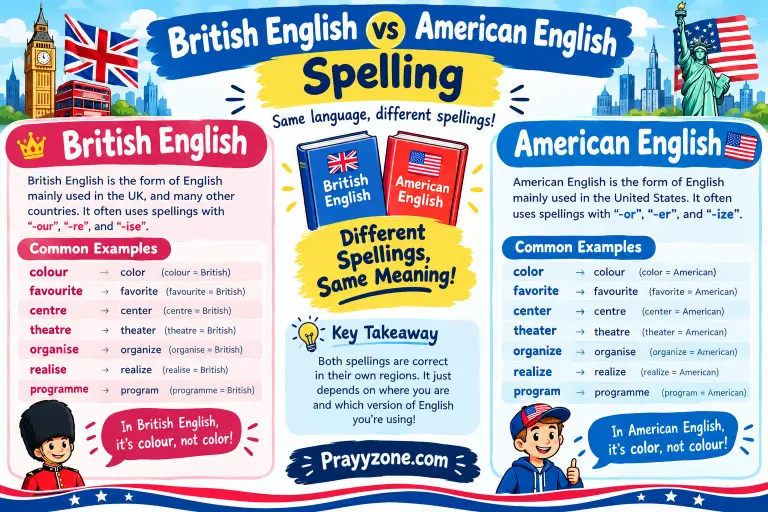
Unlike pairs such as colour/color or centre/center, humbleness and humility do not represent British and American spelling differences.
Both forms can be used in British and American English.
| Feature | British English | American English |
| Humbleness | Correct | Correct |
| Humility | Correct | Correct |
| Main spelling difference | None | None |
| Preferred formal choice | Humility | Humility |
| Casual/general choice | Humbleness or humility | Humbleness or humility |
For example:
British English:
“Her humility was admired by her colleagues.”
American English:
“Her humility was admired by her colleagues.”
The spelling stays the same.
Which Spelling Should You Use?
The best choice depends on your audience and the type of writing.
For US readers
Use humility in business emails, academic writing, applications, and formal documents. Humbleness is still correct, but humility is often the smoother choice.
For UK and Commonwealth readers
The same advice applies. Humility is a strong choice for formal writing, while humbleness can be used when you want a more direct form of “being humble.”
For a global audience
Choose humility if you want the safest and most widely familiar option.
A simple rule is:
Formal writing → humility
General or descriptive writing → humbleness or humility
Common Mistakes with Humbleness or Humility
Mistake 1: Thinking humbleness is incorrect
Incorrect idea: “Humbleness is not a real English word.”
Correction: Humbleness is a valid noun meaning the quality or state of being humble.
Mistake 2: Treating the words as spelling variants
They are not spelling variants like color and colour.
Humbleness and humility are two different noun forms.
Mistake 3: Using humble as a noun
Incorrect:
- “His humble was inspiring.”
Correct:
- “His humility was inspiring.”
- “His humbleness was inspiring.”
Mistake 4: Assuming humility means weakness
Humility does not simply mean weakness. It usually describes a person who does not consider themselves better than others. Cambridge defines humility as a lack of pride and awareness of one’s limitations.
Mistake 5: Using humbleness in every formal sentence
While correct, humility often sounds more natural in formal English.
Instead of:
- “The manager showed great humbleness.”
You could write:
- “The manager showed great humility.”
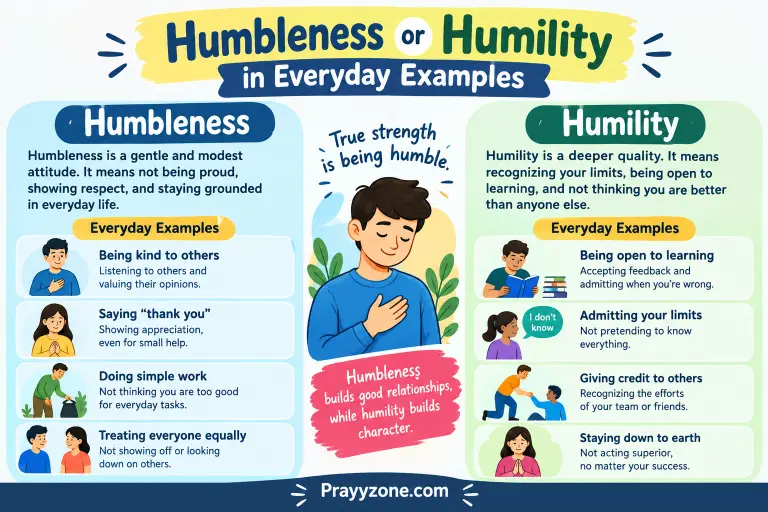
Humbleness or Humility in Everyday Examples
In Emails
Formal:
Your humility and willingness to listen make you an excellent mentor.
Less formal:
I really admire your humbleness and kindness.
In News Writing
News stories may use either word when describing a person’s character.
- The athlete was praised for his humility after the victory.
- His humbleness surprised fans who expected a more confident attitude.
On Social Media
Social media is more flexible:
- “Success means nothing without humility.”
- “Her humbleness is one of the things I admire most.”
In Formal Writing
Humility is usually the stronger choice:
- “Humility is an important quality in effective leadership.”
- “The experience taught him the importance of humility.”
In Everyday Speech
Both can work:
- “I like his humility.”
- “I like his humbleness.”
The first sentence is generally more natural.
Humbleness or Humility – Google Trends & Usage Data
Google Trends measures relative search interest, rather than giving a simple worldwide count of how many times a word is used. Its data can be explored by country, time period, and search topic.
For humbleness or humility, search interest should be treated as a guide to what people search for, not as a complete measure of English usage.
In practical English, humility is the more established choice in formal contexts. Major dictionaries define humility directly and provide many formal examples.
Humbleness remains a valid word and appears in dictionaries and real-world English examples. Cambridge also records examples from its English Corpus.
Usage comparison
| Variation | Meaning | Typical context | Recommended? |
| Humility | Being humble | Formal and professional | Yes |
| Humbleness | Being humble | General and descriptive | Yes |
| Sense of humility | Awareness of one’s limits | Formal/common | Excellent |
| Sense of humbleness | Feeling or quality of being humble | General | Correct |
| Great humility | Strong quality of being humble | Formal | Excellent |
| Great humbleness | Strong quality of being humble | General | Correct |
For content, using both terms naturally can also help answer readers who search for either expression.
FAQs About Humbleness or Humility
1. Is humbleness a correct word?
Yes. Humbleness is a correct English noun. It means the quality or state of being humble.
2. Is humility better than humbleness?
In most formal writing, humility is the better choice because it sounds more natural and polished.
3. Are humbleness and humility synonyms?
Yes. They have very similar meanings and can often replace each other. However, their style and frequency can differ.
4. Which word is more formal?
Humility is generally more formal and common in academic, professional, and serious writing.
5. Is humbleness used in British English?
Yes. Humbleness is used in British English and is not an American-only word. Cambridge lists the word as English vocabulary.
6. Is humbleness used in American English?
Yes. American dictionaries also recognize humbleness as a noun.
7. Which should I use in an essay?
Use humility in most essays. It is concise, clear, and formal.
Conclusion
Humbleness or humility is not a question of right versus wrong spelling. Both are correct English nouns. The real difference is usage and style. Humbleness means the quality or state of being humble, while humility carries the same core meaning and is often the more natural choice in formal writing.
If you are writing an essay, business email, report, application, or professional article, humility is usually the safest option. It is clear, polished, and widely understood. Humbleness is still useful, especially in everyday, descriptive, or personal writing.
The two words also work in both British and American English. They are not regional spelling variants like colour and color. Their different forms come from different historical word endings. Humbleness developed from humble + -ness, while humility came through French and Latin forms related to humble.
When in doubt, choose humility. It will fit most formal contexts and help your writing sound natural and professional.