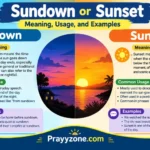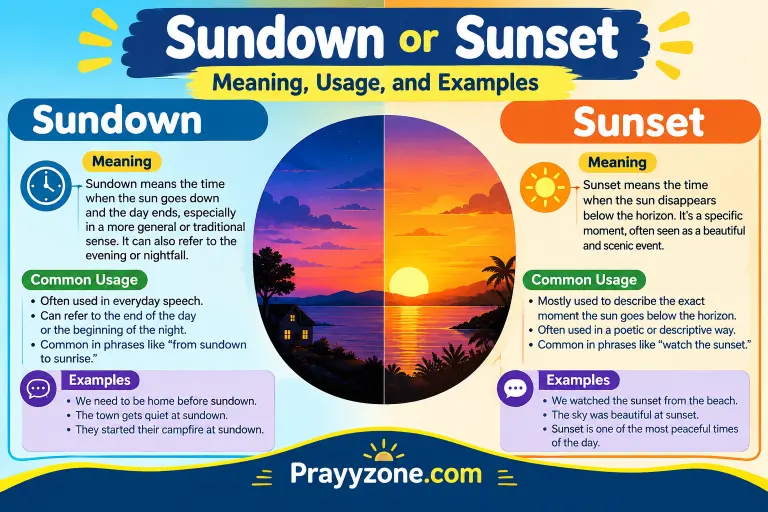
”Sundown and sunset both refer to the time when the sun goes below the horizon, but they are used slightly differently. Sunset commonly refers to the event or visible disappearance of the sun, while sundown often refers more generally to the time of day when daylight ends. For example, “We watched the sunset over the ocean,” while “The park closes at sundown.”
Have you ever wondered if sundown or sunset is the better word? Both terms describe the time when the sun goes below the horizon, so they are often used in the same way. However, they can sound different depending on the country, audience, and type of writing. This is why people search for “sundown or sunset” when writing emails, captions, school work, news stories, or formal documents.
The good news is simple: both “sundown” and “sunset” are correct English words. “Sunset” is the more common and widely understood choice, while “sundown” is especially common in North American English. Dictionaries also list “sundown” as a synonym for “sunset.”
In this guide, you will learn the difference between sundown and sunset, their origins, British and American usage, common mistakes, everyday examples, and how usage varies by context. By the end, you will know exactly which word to choose.
Sundown or Sunset – Quick Answer
Sundown and sunset usually mean the same thing: the time when the sun goes below the horizon in the evening.
| Word | Meaning | Common use |
| Sundown | The time when the sun goes down | Especially North American English |
| Sunset | The setting of the sun or the time it happens | Widely used internationally |
Examples
- We arrived home before sundown.
- We watched the sunset from the beach.
- The park closes at sundown.
- The sky looked beautiful at sunset.
There is no spelling difference between British and American English for these words. The main difference is preference and frequency, not spelling.
The Origin of Sundown or Sunset
The two words have different histories, although both describe the same natural event.
Sunset is the older word. English records it from before the 12th century. It combines sun with set, referring to the apparent descent of the sun below the horizon.
Sundown appeared later. Its recorded history goes back to the early 1600s. It combines sun and down, describing the sun going down. Etymologists also connect it with the older expression sun-go-down.
So, the words are not spelling variations of one another. They are two different English compounds with closely related meanings.
British English vs American English Spelling
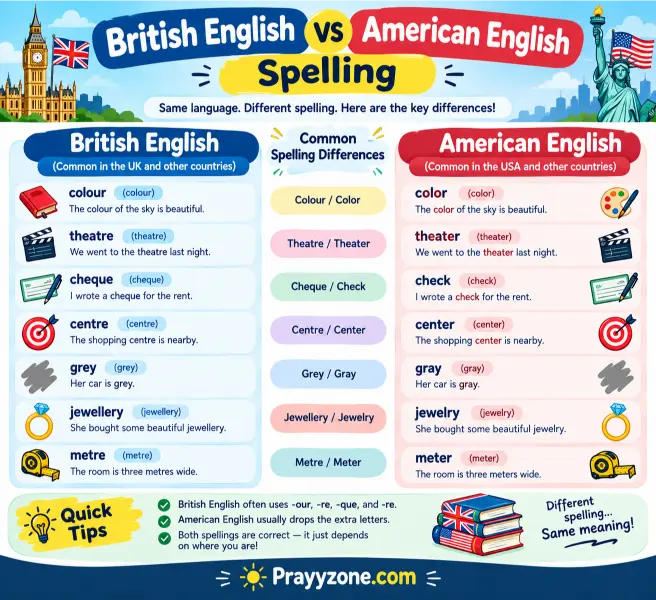
There is no major spelling difference between British and American English for either word.
The difference is mainly in word choice.
| English variety | Preferred term | Example |
| American English | Sundown or sunset | We need to leave before sundown. |
| British English | Sunset | We watched the sunset. |
| Canadian English | Sunset or sundown | The event ends at sunset. |
| Australian English | Sunset or sundown | We returned before sunset. |
| International English | Sunset | The sunset was beautiful. |
Collins notes that sundown is mainly US in usage, while British English generally uses sunset. Oxford also describes sundown as especially common in North American English.
Spelling comparison
| Correct form | Incorrect form |
| sunset | sun set, when used as the noun |
| sundown | sun down, when used as the noun |
| sunsets | sun sets, when used as a noun |
| sundowns | sun downs, when used as a noun |
Remember that “sun sets” can be correct when sets is a verb:
The sun sets at 7 p.m.
But:
We watched the sunset.
Which Spelling Should You Use?
Choose based on your audience.
For American English
Sundown is a natural choice, especially in phrases about a deadline or time.
The gates close at sundown.
Sunset is also completely correct.
For British English
Sunset is usually the safer and more natural choice.
We reached the village before sunset.
For Commonwealth English
In countries such as Canada and Australia, both words can appear. Sunset is a broadly understood option.
For global English
If your readers come from many countries, choose sunset. It is clear, familiar, and widely understood.
Best general advice: Use sunset when you want the most neutral word. Use sundown when it fits the tone or regional style.
Common Mistakes with Sundown or Sunset
1. Writing “sun set” as a noun
Incorrect:
We enjoyed the sun set.
Correct:
We enjoyed the sunset.
2. Writing “sun down” as a noun
Incorrect:
We arrived before sun down.
Correct:
We arrived before sundown.
3. Assuming one word is wrong
Both sundown and sunset are correct.
4. Using “sunset” only for the colors
Sunset can refer to both the event and the time.
Sunset is at 7:30 p.m.
It can also describe the visible scene:
The sunset was beautiful.
5. Confusing sunset with dusk
These terms are related but not identical. Sunset is the time the sun goes below the horizon. Dusk refers to the period of fading light that follows sunset.
Sundown or Sunset in Everyday Examples
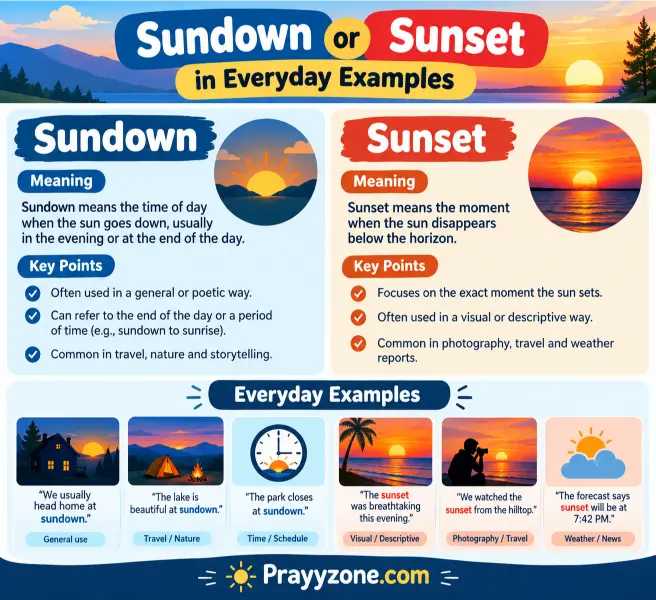
In emails
Please arrive before sunset.
Or:
Please return before sundown.
Both are grammatically correct.
In news writing
Officials said the road would reopen before sunset.
Sunset often sounds neutral and factual, making it a strong choice for general news writing.
On social media
Nothing beats a beautiful sunset.
Or:
A quiet evening at sundown.
Both work well. Sunset is especially common in captions because it directly describes the visual scene.
In formal writing
The ceremony will begin shortly after sunset.
This sounds clear and professional.
In everyday speech
Let’s get home before sundown.
This sounds natural, especially in American English.
Sundown or Sunset – Google Trends & Usage Data
Google Trends can show relative search interest for terms such as “sundown” and “sunset.” It is important to understand that Google Trends measures relative search interest, not the total number of times a word is used in everyday speech or writing.
In general, sunset has broader international recognition and usage, while sundown has a stronger North American association. Dictionary sources support this regional difference: Collins labels sundown as mainly US, and Oxford describes it as especially North American.
Search interest can also change based on context. For example:
- Sunset is common in photography, travel, weather, nature, and social media.
- Sundown is common when referring to a time limit or evening deadline.
- Both terms appear in literature, news, and everyday conversation.
For content aimed at a worldwide audience, sunset is usually the stronger general keyword. For US-focused content, sundown can be useful when it matches the searcher’s wording.
Sundown vs Sunset: Comparison Table
| Feature | Sundown | Sunset |
| Meaning | Time when the sun goes down | Setting of the sun |
| Correct spelling | Yes | Yes |
| British English | Less common | More common |
| American English | Common | Common |
| Global use | Moderate | Very widespread |
| Formal writing | Correct | Usually preferred |
| Social media | Natural | Very common |
| Refers to evening | Yes | Yes |
| Refers to the visual event | Yes | Yes |
| Best neutral choice | Good | Best |
FAQs About Sundown or Sunset
1. Is sundown the same as sunset?
Yes. Sundown is a synonym for sunset and usually refers to the time when the sun goes below the horizon.
2. Is sunset one word or two?
Sunset is one word when used as a noun.
Correct: We watched the sunset.
3. Is sundown one word or two?
Sundown is one word when used as a noun.
Correct: We returned before sundown.
4. Is sundown American English?
It is used in many varieties of English, but dictionaries identify it as especially common or mainly used in North American English.
5. Is sunset better than sundown?
Not always. Both are correct. Sunset is usually the safer choice for international and formal writing.
6. Can I use sundown in British English?
Yes. British English speakers understand it, but sunset is generally more usual.
7. What is the difference between sunset and dusk?
Sunset is when the sun goes below the horizon. Dusk is the period of reduced daylight that follows sunset.
Conclusion
When choosing between sundown or sunset, you usually do not need to worry about correctness. Both are standard English words, and both describe the time when the sun goes below the horizon. The main difference is regional preference and context.
Sunset is the best all-purpose choice. It is widely understood in American, British, Commonwealth, and international English. It also works well in formal writing, news, travel content, photography, social media, and everyday conversation.
Sundown is also correct. It has a stronger North American feel and often sounds natural when talking about a deadline or a time by which something should happen. For example, “return before sundown” is perfectly natural.
There is no British-versus-American spelling change such as colour and color. The words are simply different compounds. If you want a neutral word for a worldwide audience, choose sunset. If your audience is mainly American or the phrase naturally calls for it, sundown is an excellent choice.
Read More Articles
- Beak or Beek: Which Spelling Is Correct?
- Fifthteen or Fifteen: Which Spelling Is Correct?
- Star or David: Correct Spelling, Meaning, History, and Usage