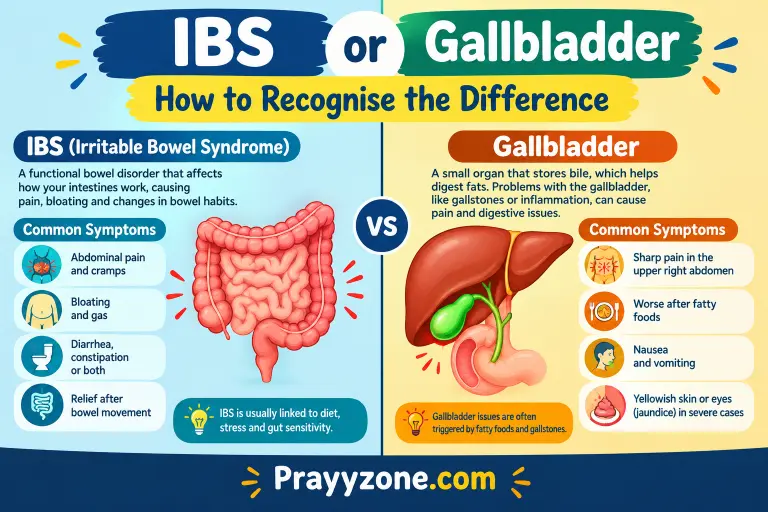
IBS (irritable bowel syndrome) and gallbladder problems can both cause abdominal discomfort, but their symptoms often differ. IBS commonly involves recurring abdominal pain linked with changes in bowel habits, such as diarrhoea, constipation, or both. Gallbladder problems may cause pain in the upper right or upper middle abdomen, particularly after eating fatty meals, sometimes with nausea or vomiting. Because symptoms can overlap, persistent or severe abdominal pain should be evaluated by a healthcare professional.
When stomach pain keeps coming back, it can be hard to know what is causing it. People often search for “IBS or gallbladder” because the symptoms can overlap. Both can cause abdominal discomfort, bloating, nausea, and changes after eating. But IBS and gallbladder problems are different conditions that affect different parts of the digestive system.
IBS, or irritable bowel syndrome, mainly affects bowel function. Typical symptoms include repeated abdominal pain linked with bowel movements, along with diarrhea, constipation, or both.
The gallbladder is a small organ under the liver. It stores bile. Gallbladder problems, especially gallstones, can cause pain in the upper-right abdomen.
This guide explains IBS or gallbladder in simple terms. It covers the differences, word origins, common mistakes, everyday usage, search trends, and questions people often ask. It is educational and cannot diagnose a health problem.
IBS or Gallbladder – Quick Answer
| Feature | IBS | Gallbladder Problems |
| Full name | Irritable bowel syndrome | Gallbladder disease/problems |
| Main area | Bowel and digestive system | Gallbladder and bile ducts |
| Common symptoms | Abdominal pain, bloating, diarrhea, constipation | Upper-right abdominal pain, nausea, vomiting |
| Bowel changes | Common | Not usually the main feature |
| Gallstones | No | Can be a major cause |
| Diagnosis | Symptom pattern and medical assessment | Medical history, blood tests, and imaging |
IBS commonly involves abdominal pain and changes in bowel movements. Gallstones can cause sudden pain, often in the upper-right abdomen, when they block bile ducts.
A person should not assume that abdominal pain is IBS or a gallbladder problem based only on symptoms. A healthcare professional can determine the cause.
The Origin of IBS or Gallbladder
The two terms have very different histories.
IBS stands for irritable bowel syndrome. The current medical term became established in the 1940s. Historical medical literature describes earlier names, including “mucous colitis” and “spastic colon.” The modern term helped describe a group of symptoms involving abdominal pain and altered bowel habits.
The word gallbladder comes from gall + bladder. “Gall” is an old English word connected with bile. The compound word has been recorded for centuries.
Unlike spelling pairs such as color/colour, IBS and gallbladder are not alternative spellings of one word. They are names for different medical concepts.
British English vs American English Spelling

There is little spelling difference between IBS and gallbladder in British and American English.
The main point of variation is gallbladder vs gall bladder. Dictionaries recognize both forms, although gallbladder is widely used as the standard closed compound.
| Term | American English | British English | Meaning |
| IBS | IBS | IBS | Irritable bowel syndrome |
| Irritable bowel syndrome | Common | Common | A digestive disorder |
| Gallbladder | Common | Common | Organ that stores bile |
| Gall bladder | Also used | Also used | Variant form |
| Gallstone | Common | Common | A stone formed in the gallbladder |
So, there is no major US-versus-UK spelling conflict with IBS.
Which Spelling Should You Use?
For professional writing, the safest choices are:
- IBS after first writing irritable bowel syndrome.
- gallbladder as one word.
- gallstones as one word.
- Use gall bladder only when following a particular source or style.
For a US audience, “gallbladder” is a clear and familiar choice.
Irritable bowel syndrome (IBS) and gallbladder problems can cause different types of abdominal symptoms.
This makes the article clear to readers who may not know the abbreviation.
Common Mistakes with IBS or Gallbladder
Here are some common mistakes:
Mistake: “IBS is a gallbladder disease.”
Correction: IBS and gallbladder disorders are different conditions.
Mistake: “Gallbladder” means gallstones.
Correction: The gallbladder is an organ. Gallstones are hard particles that can form inside it.
Mistake: “IBS always causes diarrhea.”
Correction: IBS may involve diarrhea, constipation, or both.
Mistake: “Upper-right abdominal pain always means gallstones.”
Correction: Several conditions can cause abdominal pain, so symptoms alone cannot confirm the cause.
Mistake: “IBS damages the bowel.”
Correction: IBS is associated with symptoms without visible signs of damage to the digestive tract.
Mistake: Using “IBS” without explaining it.
Correction: Write irritable bowel syndrome (IBS) the first time.
IBS or Gallbladder in Everyday Examples
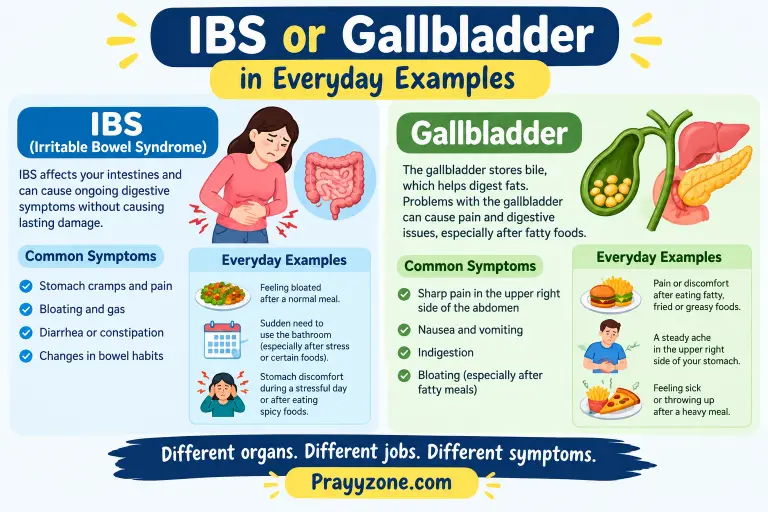
In an Email
“I have been experiencing digestive symptoms and plan to discuss them with my healthcare provider.”
In News Writing
“Researchers continue to study digestive disorders such as irritable bowel syndrome and gallbladder disease.”
On Social Media
“I’m learning more about the difference between IBS symptoms and gallbladder problems.”
In Formal Writing
“IBS and gallbladder disorders should be considered separate medical conditions because they involve different parts of the digestive system.”
In a Health Article
“IBS may cause abdominal pain and changes in bowel habits, while gallstones may cause attacks of upper-right abdominal pain.”
IBS or Gallbladder – Google Trends & Usage Data
Search interest in “IBS or gallbladder” reflects a practical health question rather than a spelling question. People may use the phrase when trying to understand which condition could explain digestive symptoms.
There is no reliable basis for giving a fixed worldwide Google Trends score without specifying a country, date range, and search category. Google Trends results can change over time and can differ greatly between countries.
In general, searches involving IBS tend to appear in discussions about:
- Abdominal pain
- Bloating
- Constipation
- Diarrhea
- Food and digestive symptoms
Searches involving gallbladder commonly relate to:
- Gallstones
- Upper-right abdominal pain
- Gallbladder attacks
- Ultrasound
- Gallbladder removal
Gallstones are common, affecting about 10–15% of the U.S. population, according to NIDDK.
IBS vs Gallbladder: Keyword Variations
| Search phrase | What the user may mean |
| IBS or gallbladder | Comparing possible causes of symptoms |
| IBS vs gallbladder | Looking for differences |
| IBS or gallstones | Comparing IBS with gallstone symptoms |
| IBS gallbladder symptoms | Asking if symptoms overlap |
| IBS and gallbladder | Asking if both can occur together |
| gallbladder or IBS pain | Trying to understand abdominal pain |
| IBS vs gallstones symptoms | Comparing symptom patterns |
FAQs About IBS or Gallbladder
1. Is IBS the same as a gallbladder problem?
No. IBS is a disorder involving abdominal symptoms and changes in bowel movements. Gallbladder problems involve the gallbladder or related bile ducts.
2. Can IBS cause upper-right abdominal pain?
IBS can cause abdominal pain in different areas. However, upper-right abdominal pain can also have other causes, including gallbladder problems. The location alone cannot establish a diagnosis.
3. What does gallbladder pain usually feel like?
Gallbladder attacks from gallstones commonly cause pain in the upper-right abdomen.
4. Can gallstones cause digestive symptoms?
Yes. Gallstones can cause symptoms when they block bile ducts. They can also lead to complications involving the gallbladder, bile ducts, liver, or pancreas.
5. How is IBS diagnosed?
Doctors look at the pattern of symptoms and medical history and may perform a physical examination.
6. How are gallstones diagnosed?
Healthcare professionals may use medical history, a physical examination, blood tests, and imaging. Ultrasound is commonly used to find gallstones.
7. When should someone seek medical care?
Severe or persistent abdominal pain, fever, repeated vomiting, yellowing of the skin or eyes, or other concerning symptoms should be assessed promptly by a healthcare professional. Gallstones that block bile ducts can cause serious complications.
Conclusion
The phrase “IBS or gallbladder” usually reflects a search for the difference between two very different digestive health issues. IBS stands for irritable bowel syndrome and commonly involves repeated abdominal pain, bloating, and changes in bowel movements such as diarrhea or constipation.
The gallbladder is a small organ that stores bile. Gallstones can develop inside it and may cause sudden upper-right abdominal pain when they block bile ducts.
For writing, IBS is the standard abbreviation, while gallbladder is the clearest standard spelling. “Gall bladder” also appears as a variant, but there is no major British-versus-American spelling difference between these terms.
Most importantly, symptoms can overlap with many digestive conditions. An online article cannot determine if someone has IBS, gallstones, or another condition. Persistent, severe, or worrying symptoms should be discussed with a qualified healthcare professional.
Read More Articles:
- Vizio or Hisense: Which TV Brand Is Better?
- Bacitracin or Neosporin: Which One Should You Choose?
- Cockroach or Cricket: What’s the Difference?