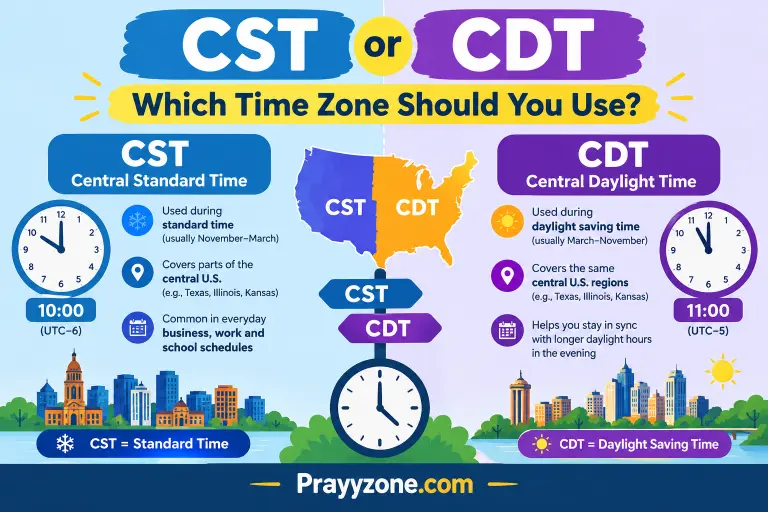
”CST and CDT are both used for the Central Time Zone in North America, but they apply during different parts of the year. CST (Central Standard Time) is UTC−6 and is generally used during standard time, while CDT (Central Daylight Time) is UTC−5 and is used during daylight saving time. Use the abbreviation that matches the date and if daylight saving time is in effect.”
If you have ever scheduled a meeting with someone in the United States, you may have seen CST or CDT and wondered which time is correct. These two abbreviations are closely related, but they are not interchangeable. Both refer to the Central Time Zone in North America, but they apply during different parts of the year.
CST means Central Standard Time and is UTC−6. CDT means Central Daylight Time and is UTC−5. The change happens because many areas in the Central Time Zone use Daylight Saving Time. In the United States, clocks move forward in March and back in November under current federal rules.
People often search for “CST or CDT” when converting times, arranging online meetings, writing business emails, or checking event schedules. The main confusion is simple: CST is used during standard time, while CDT is used during daylight time. This guide explains the difference, history, correct usage, common mistakes, and practical examples.
CST or CDT – Quick Answer
CST = Central Standard Time = UTC−6
CDT = Central Daylight Time = UTC−5
The Central Time Zone changes between these two abbreviations when Daylight Saving Time is observed. NIST lists Central Standard Time as UTC−6 and Central Daylight Time as UTC−5.
| Abbreviation | Full Name | UTC Offset | When Used |
| CST | Central Standard Time | UTC−6 | Standard time |
| CDT | Central Daylight Time | UTC−5 | Daylight Saving Time |
| CT | Central Time | Changes | General year-round reference |
Example:
- “The meeting starts at 10:00 a.m. CST.” → Standard time
- “The meeting starts at 10:00 a.m. CDT.” → Daylight time
- “The meeting starts at 10:00 a.m. CT.” → A year-round Central Time reference
For schedules that cover different seasons, CT can be clearer than choosing CST or CDT.
The Origin of CST or CDT
The terms CST and CDT come from the words Central, Standard, and Daylight.
The Central Time Zone is one of the major North American time zones. Modern time zones developed to make clocks consistent across large areas. NIST notes that standardized time zones in the United States and Canada developed in the 1880s, with railroads playing an important role.
The word standard refers to the normal time used when Daylight Saving Time is not active. The word daylight refers to the period when clocks are moved one hour forward.
The abbreviations therefore have a logical pattern:
- C = Central
- S = Standard
- D = Daylight
- T = Time
The difference is not a spelling variation. It is a difference in the clock time used during different parts of the year.
British English vs American English Spelling
Unlike words such as color and colour, CST and CDT do not have British and American spelling versions. They are time-zone abbreviations.
The bigger difference is how people communicate time. American writing commonly uses CST, CDT, or CT when discussing North American Central Time. British English usually uses terms such as GMT or BST for UK time instead.
| Feature | American English | British English |
| Central Standard Time | CST | CST when referring to North American time |
| Central Daylight Time | CDT | CDT when referring to North American time |
| General Central Time | CT | CT when referring to North American time |
| UK standard time | GMT | GMT |
| UK summer time | BST | BST |
| Main difference | Usage depends on the location | Usage depends on the location |
So, CST is not an American spelling and CDT is not a British spelling. They identify different time standards.
Which Spelling Should You Use?
Use the abbreviation that matches the time being discussed.
For a US audience
Use CST during Central Standard Time and CDT during Central Daylight Time.
For UK or Commonwealth readers
If you are discussing a North American event, keep the correct North American abbreviation. Do not change CST to a British spelling.
For a global audience
CT can be useful when the exact seasonal abbreviation is not important. Even better, include the UTC offset when precision matters.
For example:
“The webinar begins at 10:00 a.m. Central Time (UTC−5).”
This is clearer for international readers.
Common Mistakes with CST or CDT
1. Treating CST and CDT as the same
They have different UTC offsets.
Incorrect: “CST and CDT are always UTC−6.”
Correct: CST is UTC−6, while CDT is UTC−5.
2. Using CST during daylight time
When Daylight Saving Time is active, CDT is the correct Central Time abbreviation in areas observing DST.
3. Assuming every place uses DST
Not every region follows the same daylight-saving rules. NIST notes that most of the United States observes DST, while some areas do not.
4. Forgetting the location
“10:00 CST” can be confusing for an international audience.
A better option is:
10:00 a.m. Central Time (UTC−5)
5. Confusing CST with other meanings
CST can have meanings outside time zones. In a time-related context, it normally means Central Standard Time, but context matters.
CST or CDT in Everyday Examples
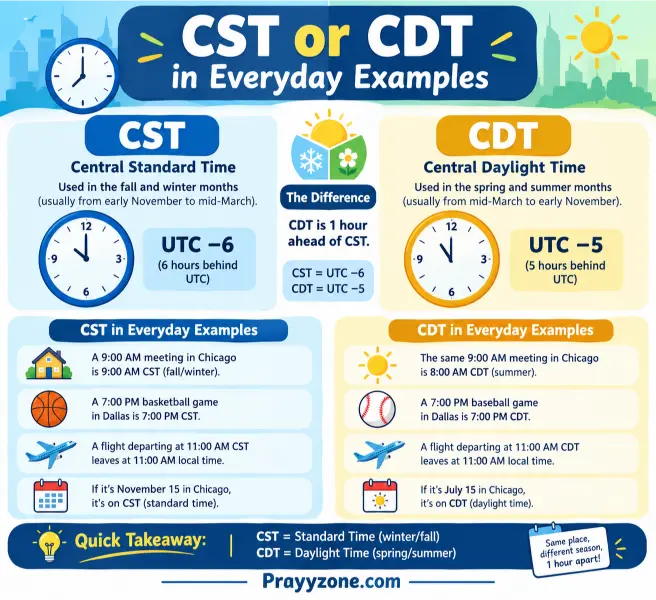
In an email
“Our online meeting begins at 2:00 p.m. CDT.”
This tells readers that the time is based on Central Daylight Time.
In a news article
“The event starts at 7:00 p.m. CDT.”
This is useful when reporting an event for readers in different locations.
On social media
“The livestream begins at 8 p.m. CT.”
Using CT can make a recurring schedule easier to maintain throughout the year.
In formal writing
“The application deadline is 5:00 p.m. Central Time (UTC−5).”
This format is especially clear for international readers.
In a calendar invitation
A calendar system will often handle daylight-saving changes automatically when the correct time zone is selected. This is usually safer than manually changing CST to CDT.
CST or CDT – Google Trends & Usage Data
Search interest for “CST or CDT” is closely linked to practical time-zone questions. People commonly search these terms when they need to:
- Convert a meeting time
- Understand a calendar invitation
- Check if daylight saving is active
- Schedule international events
- Understand a TV or livestream time
- Convert Central Time to another time zone
Exact Google Trends numbers can change over time, so a fixed ranking should not be treated as permanent. Search volume also varies by country and season.
The biggest practical distinction is seasonal. In the United States, Daylight Saving Time currently begins on the second Sunday in March and ends on the first Sunday in November.
This means searches for CST vs CDT often become more useful around the March and November clock changes.
For international users, UTC offsets can be more useful than the abbreviations because abbreviations can be unfamiliar or ambiguous.
CST and CDT Variations Side by Side
| Term | Meaning | UTC Offset | Main Use |
| CST | Central Standard Time | −6 | Standard time |
| CDT | Central Daylight Time | −5 | Daylight time |
| CT | Central Time | −6 or −5 | General Central Time |
| UTC | Coordinated Universal Time | 0 | International reference |
| CST/CDT | Seasonal Central Time | Changes | Comparing the two |
NIST confirms the Central Time Zone’s standard offset is UTC−6 and its daylight offset is UTC−5.
FAQs About CST or CDT
1. Is CST the same as CDT?
No. CST is Central Standard Time, while CDT is Central Daylight Time.
2. Which is ahead, CST or CDT?
CDT is one hour ahead of CST because CDT is UTC−5 while CST is UTC−6.
3. Is Chicago CST or CDT?
Chicago uses Central Time and observes Daylight Saving Time, so its abbreviation changes between CST and CDT depending on the season.
4. When does CST change to CDT?
In the United States, the Central Time Zone changes to daylight time when DST begins. Under current rules, that occurs on the second Sunday in March.
5. When does CDT change back to CST?
Under current US rules, Daylight Saving Time ends on the first Sunday in November, when clocks move back one hour.
6. Should I write CST or CDT in an email?
Use the abbreviation that is correct for the date of the event. If the audience is international, adding the UTC offset is even clearer.
7. Is CT better than CST or CDT?
For a general year-round schedule, CT can be easier because it does not require you to change the abbreviation when the season changes. For a specific date, CST or CDT gives more detail.
Conclusion
Understanding CST or CDT is simple once you remember one key difference: CST is Central Standard Time, while CDT is Central Daylight Time. CST is UTC−6, and CDT is UTC−5.
The two abbreviations describe the same general Central Time region but apply under different clock settings. In the United States, many Central Time locations use Daylight Saving Time from March to November. During that period, CDT is used. During standard time, CST is used.
For everyday communication, choose the abbreviation that matches the date. If you are writing for people in several countries, consider using Central Time (CT) with a UTC offset. This reduces confusion and makes schedules easier to understand.
The most important lesson is that CST and CDT are not spelling alternatives. They are different time-zone abbreviations. Knowing when each one applies helps you write clearer emails, schedules, event announcements, and professional documents.
Read More Articles
- Steelers or Ravens: Which NFL Team Is Better?
- Coarse or Course: Which Spelling Is Correct?
- Mercari or Poshmark: Which Marketplace Is Better for Buying and Selling?