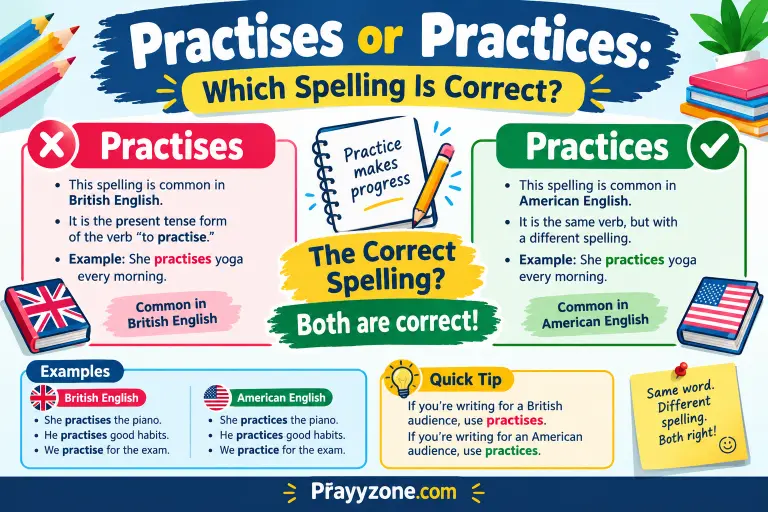
”Practices and practises are both correct, depending on the variety of English. Practices is the standard spelling in American English for both the noun and verb, while British English uses practice as the noun and practise as the verb. For example, “She practises the piano” is British English, while “She practices the piano” is American English.”
Have you ever typed “practises or practices” and wondered which one is correct? You are not alone. These two spellings look almost the same, but their use depends on the type of English you are writing.
The main difference is between British English and American English. In British English, practice is usually a noun, while practise is the verb. For example, you might say, “She needs more practice,” but “She practises the piano every day.” In American English, practice is used for both the noun and the verb.
The spelling practises can be confusing because it is the third-person singular form of the British English verb practise. For example, “He practises football every weekend.” In American English, the same sentence uses practices: “He practices football every weekend.”
Understanding this small difference can help you write clearly and avoid spelling mistakes in schoolwork, emails, websites, and professional documents.
Practises or Practices – Quick Answer
Both practises and practices can be correct. The correct spelling depends on the type of English you use.
- British English: practises = verb
- American English: practices = verb
- British and American English: practices = plural noun
Examples
British English:
- She practises the piano every day.
- He practises his speech before the event.
American English:
- She practices the piano every day.
- He practices his speech before the event.
As a noun:
- The doctor has three medical practices.
- Good study practices can improve learning.
So, if you are writing in British English, use practises for the verb. If you are writing in American English, use practices for the verb.
The Origin of Practises or Practices
The words practice and practise come from the same older word. Their history can be traced through French and Latin, with roots connected to doing, acting, and putting knowledge into use.
English later developed different spelling rules for the noun and verb in British English. The noun became practice, while the verb became practise.
This creates the common British English pair:
- practice noun
- practise verb
When the verb is used with he, she, or it, the ending changes:
- practise → practises
American English simplified this system. It normally uses practice for both the noun and verb:
- practice noun
- practice verb
- practices third-person singular verb or plural noun
This is why British and American writers may spell the same sentence differently.
British English vs American English Spelling
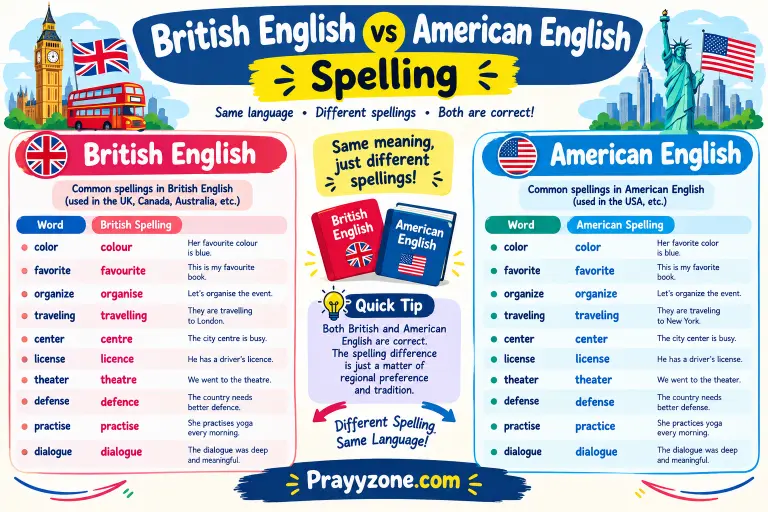
The key difference is simple.
| Meaning | British English | American English |
| Noun, singular | practice | practice |
| Noun, plural | practices | practices |
| Verb, base form | practise | practice |
| Verb, he/she/it | practises | practices |
| Verb, past tense | practised | practiced |
| Verb, -ing form | practising | practicing |
Examples
| British English | American English |
| She practises every morning. | She practices every morning. |
| He practised his speech. | He practiced his speech. |
| They are practising for the match. | They are practicing for the game. |
| Regular practice helps. | Regular practice helps. |
The British spelling follows the pattern -ise, while the American spelling uses -ize for this verb family.
Which Spelling Should You Use?
Choose the spelling based on your audience.
For American readers
Use practice as the verb.
Example:
She practices English every evening.
Use practices when you need the third-person singular verb or plural noun.
For British and Commonwealth readers
Use practise as the verb and practice as the noun.
Example:
She practises English every evening.
This spelling is common in British English and is also used in several countries that follow British English conventions.
For a global audience
Consistency is more important than mixing systems. Choose one style and use it throughout your article, website, or document.
If your website targets the United States, use American spelling. If it targets the United Kingdom, use British spelling.
Common Mistakes with Practises or Practices
Mistake 1: Using “practises” in American English
Incorrect for standard American English:
She practises the piano every day.
Correct:
She practices the piano every day.
Mistake 2: Using “practices” as a British verb
In standard British English, this is usually incorrect:
He practices his pronunciation every day.
Correct:
He practises his pronunciation every day.
Mistake 3: Confusing the noun and verb
British English uses practice as a noun.
Correct:
Regular practice improves your skills.
It uses practise as a verb.
Correct:
I practise every day.
Mistake 4: Mixing spelling styles
Avoid writing:
She practises every day, but she practiced yesterday.
For British English, write:
She practises every day, but she practised yesterday.
For American English, write:
She practices every day, but she practiced yesterday.
Practises or Practices in Everyday Examples
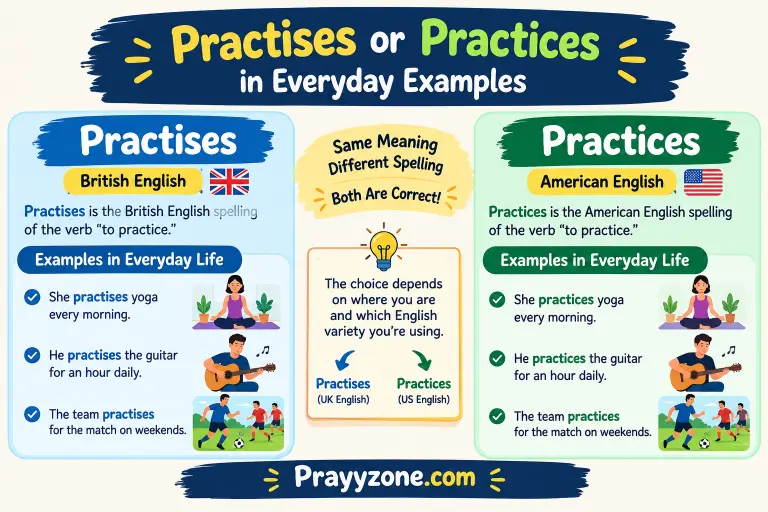
In emails
British English:
Sarah practises her presentation before each meeting.
American English:
Sarah practices her presentation before each meeting.
In news writing
British English:
The athlete practises every morning before the competition.
American English:
The athlete practices every morning before the competition.
In social media
A British English user might write:
He practises guitar every day.
An American English user might write:
He practices guitar every day.
Both communicate the same idea.
In formal writing
For British English:
The student practises the required skills throughout the course.
For American English:
The student practices the required skills throughout the course.
The important point is to follow the spelling system used by your intended audience.
Practises or Practices – Google Trends & Usage Data
Search interest for “practises or practices” reflects a wider spelling difference between British and American English. The exact level of interest can change over time, so Google Trends should be treated as a measure of relative search interest rather than a fixed count of searches.
The search is especially useful in countries where both British and American English are widely seen online. Users may encounter practises in British sources and practices in American sources and then search for the difference.
In general:
- United States: “practices” is the normal verb spelling.
- United Kingdom: “practises” is the standard verb spelling.
- Canada: Usage can vary, with both British and American conventions influencing English.
- Australia and New Zealand: British-style spelling is generally common, so “practises” is used as a verb.
- Global online content: American spelling is common because of the large amount of US-based digital content.
Search popularity does not decide which spelling is correct. Your target audience and style guide should decide.
Practises or Practices – Comparison Table
| Word | British English | American English | Word Type |
| practice | ✓ | ✓ | Noun |
| practise | ✓ | — | Verb |
| practises | ✓ | — | Verb |
| practices | ✓ | ✓ | Plural noun / verb |
| practised | ✓ | — | Past-tense verb |
| practiced | — | ✓ | Past-tense verb |
| practising | ✓ | — | -ing verb |
| practicing | — | ✓ | -ing verb |
FAQs About Practises or Practices
1. Is “practises” correct?
Yes. Practises is correct in British English when it is the third-person singular form of the verb practise.
Example: “She practises tennis every Saturday.”
2. Is “practices” correct?
Yes. Practices is correct in American English as a verb. It is also a plural noun in both British and American English.
3. What is the difference between practice and practise?
In British English, practice is normally a noun, while practise is a verb.
Example: “Practice makes progress.”
Example: “She practises every day.”
In American English, practice is used for both noun and verb.
4. Is “practises” British or American?
Practises is the standard British English spelling for the third-person singular verb.
5. Should I write “she practices” or “she practises”?
Use she practises in British English and she practices in American English.
6. Is “practices” always a noun?
No. Practices can be a plural noun or a verb.
Noun: “The company follows safe practices.”
Verb: “He practices every day.”
7. Which spelling is best for content?
Neither spelling is automatically better. Use the spelling that matches your target audience. If your content targets US readers, use American English. For UK readers, use British English.
Conclusion
The difference between practises or practices is mainly a British-versus-American English issue. In British English, practises is the third-person singular form of the verb practise. In American English, the same verb is spelled practices.
The noun practice is used in both forms of English, while practices can be a plural noun in both varieties. The main difference appears when the word is used as a verb.
For UK, Australian, and other audiences that commonly follow British spelling, use practise and practises for the verb. For US audiences, use practice and practices. The most important rule is consistency. Do not mix British and American spelling in the same piece of writing unless there is a clear reason to do so.
Once you remember that British English separates practice and practise, while American English uses practice for both, choosing the right spelling becomes easy.