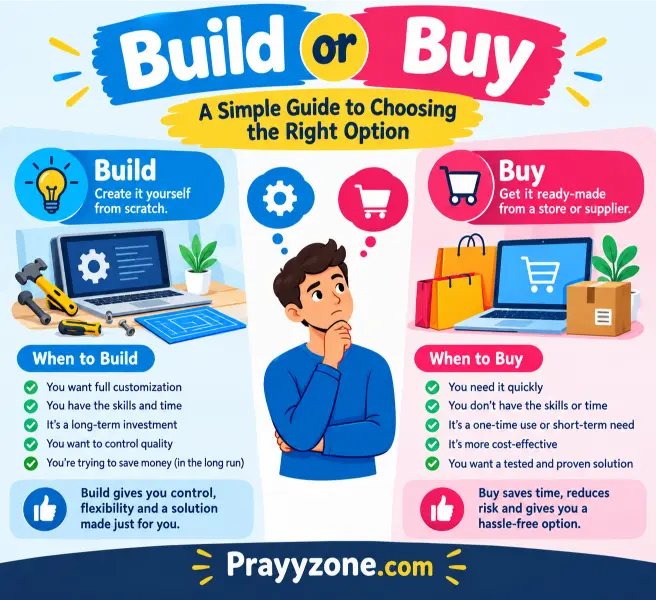
”Build and buy are two common options when deciding how to get something you need. Build means creating or customising something yourself, which can offer more control and flexibility, while buy means purchasing a ready-made option that is usually faster and more convenient. The right choice depends on factors such as cost, time, customisation, quality, and your specific needs.”
When a company needs a new tool, product, or system, one question often comes first: should we build it or buy it? The phrase “build or buy” describes this choice. It is common in business, software, technology, procurement, and project planning.
People search for “build or buy” because the phrase can be confusing. Does “build” mean making something from scratch? Does “buy” mean purchasing a finished product? In most business contexts, the answer is yes. But the best choice depends on cost, time, skills, control, risk, and long-term needs.
The question is not only about price. A product may be cheap to buy but hard to customize. A custom solution may fit perfectly but take more time and money to maintain. Modern companies also consider a third option: buying a core product and building custom features around it.
This guide explains what build or buy means, where the phrase comes from, how it is used, common mistakes, and how to choose the right option for different audiences.
Build or Buy – Quick Answer
Build or buy means deciding if to create something yourself or purchase an existing solution from another company.
For example:
- Build: A company creates its own customer-management software.
- Buy: A company purchases an existing CRM system.
- Build: A school develops its own student portal.
- Buy: A school uses a ready-made education platform.
The phrase is also called “build vs. buy” or “make or buy.” In business, the decision often considers cost, time, skills, flexibility, risk, support, and the importance of the product to the organization.
Build or Buy: Quick Comparison
| Variation | Meaning | Common Use |
| build or buy | Create or purchase | Business decisions |
| build vs. buy | Compare creating with purchasing | Technology and strategy |
| make or buy | Produce internally or purchase | Manufacturing and procurement |
| build-and-buy | Use both approaches | Hybrid projects |
| buy and extend | Purchase a product and customize it | Software |
The Origin of Build or Buy
The phrase “build or buy” comes from a basic business decision: should an organization make something internally or obtain it from an outside supplier?
A closely related phrase is “make or buy.” This has long been used in manufacturing, purchasing, and operations. As computers and business software became more common, the same idea became widely used for technology decisions.
The concept is not new. A U.S. government technology guide, for example, describes “build or buy” as a major decision when selecting technology and notes that building often takes longer than purchasing an existing solution.
Research on software acquisition also identifies factors such as requirements, cost, complexity, flexibility, time, internal expertise, support, and risk as important parts of the decision.
Today, build or buy is especially common in software and AI discussions. Recent technology guidance also includes a middle option: buying a product and extending it with custom work.
Importantly, build or buy is not a British-versus-American spelling issue. Both forms use the same spelling in British and American English. The difference is mainly in how the phrase is used and formatted.
British English vs American English Spelling
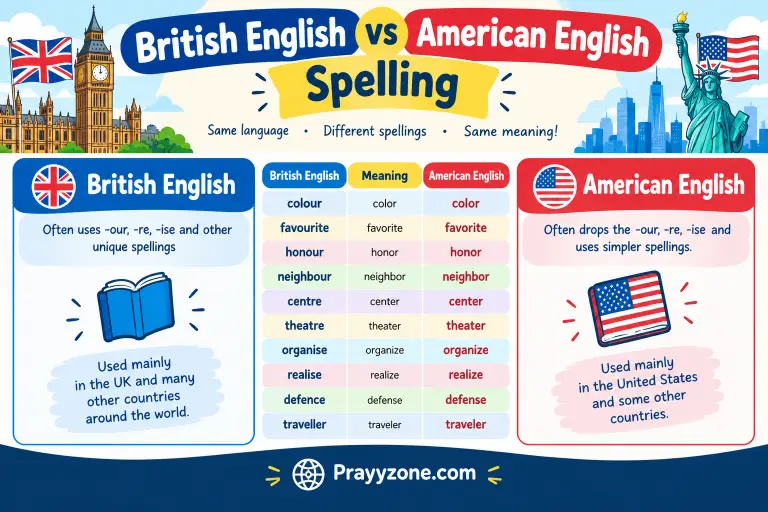
There is no major spelling difference between British English and American English for build or buy.
Both use:
- build
- buy
- built
- bought
The main difference can be style. Some writers use “build vs. buy,” while others prefer “build vs buy.” Both are widely understood.
| Feature | British English | American English |
| Main phrase | build or buy | build or buy |
| Short form | build vs buy | build vs. buy / build vs buy |
| Verb: build | build | build |
| Past tense | built | built |
| Verb: buy | buy | buy |
| Past tense | bought | bought |
| Meaning | Same | Same |
Example
British English:
Should we build or buy the software?
American English:
Should we build or buy the software?
The sentence is correct in both varieties.
Which Spelling Should You Use?
Use build or buy when you want the clearest and most natural wording.
For a US audience
You can use:
- build or buy
- build vs. buy
- make or buy
For a UK or Commonwealth audience
You can use:
- build or buy
- build vs buy
- make or buy
For a global audience
Build or buy is the safest choice because it is simple and easy to understand.
If you are writing an content article, business guide, or webpage, use the exact keyword build or buy naturally. Do not force variations into every paragraph.
Common Mistakes with Build or Buy
1. Treating “build” and “buy” as spelling alternatives
They are not spelling alternatives.
Incorrect idea:
“Which spelling is correct: build or buy?”
Better:
“Which option is better: build or buy?”
2. Writing “built or bought” when discussing the decision
The decision is normally expressed with the base verbs:
Correct:
“Should we build or buy?”
“Built or bought” usually describes something after the decision.
3. Confusing “build or buy” with “build vs. buy”
Both are correct, but they serve slightly different purposes.
- Build or buy? = asks a question.
- Build vs. buy = compares two choices.
4. Ignoring the hybrid option
Sometimes the answer is not simply build or buy. A company may buy a standard platform and build custom features around it.
This blended approach is increasingly discussed in modern technology planning.
5. Looking only at the starting price
A good decision considers the full cost over time. Building may require development, testing, maintenance, security work, and future updates. Buying may involve subscriptions, integration, customization, and vendor costs.
Build or Buy in Everyday Examples
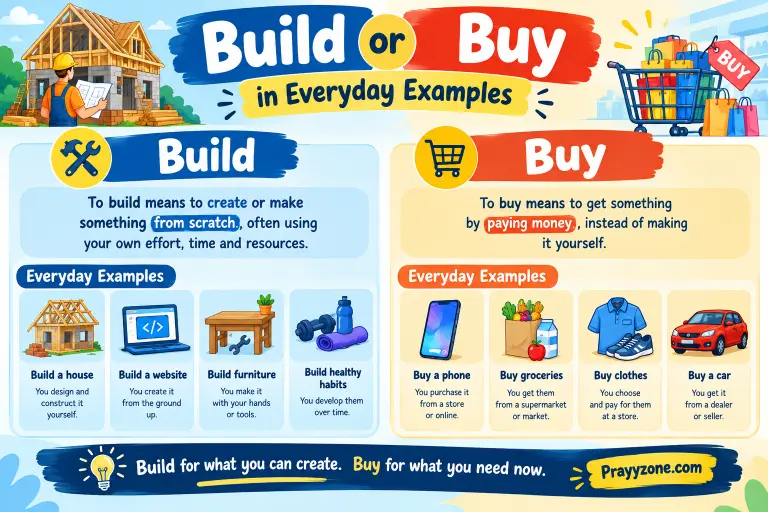
The phrase appears in many types of writing.
In an email
We need to decide if to build or buy the new reporting system.
In business news
The company is reviewing its build-or-buy strategy for new technology.
On social media
Build or buy? That’s the big question for our next software project.
In formal writing
The organization should complete a build-or-buy analysis before selecting a technology solution.
In a school or college project
Our team compared the costs and benefits of the build-or-buy options.
In technology discussions
The company chose to buy the core platform and build custom features.
Build or Buy – Google Trends & Usage Data
Search interest for build or buy is strongly connected to business and technology topics. It is not simply a general English phrase like “buy” or “build.”
The phrase appears frequently in discussions about:
- Software
- Procurement
- Business strategy
- Technology planning
- AI
- Manufacturing
- Enterprise systems
Recent 2026 technology publications continue to use build vs. buy and build or buy when discussing software and AI decisions.
The phrase also has a long history in technology literature. A 1976 technical article was already titled “Build or buy?”, showing that the wording has been used in technology decision-making for decades.
For content, usage can vary by country and industry. Business and technology audiences are more likely to search the phrase than general consumers. Exact Google Trends numbers also change over time, so a live Trends check should be used when precise country-by-country figures are required.
Build or Buy Variations: Side-by-Side Comparison
| Phrase | Meaning | Best Context |
| build or buy | Choose between creating and purchasing | General questions |
| build vs buy | Compare the two options | Articles and reports |
| build vs. buy | Same comparison | Common US style |
| make or buy | Produce internally or purchase | Manufacturing |
| build or purchase | More formal wording | Professional writing |
| buy and extend | Purchase and customize | Software |
| build and buy | Use both approaches | Hybrid strategy |
FAQs About Build or Buy
1. What does build or buy mean?
Build or buy means deciding if to create a product, system, or service internally or purchase an existing solution.
2. Is “build or buy” correct English?
Yes. Build or buy is a standard and widely used business phrase.
3. Is it “build or buy” or “build vs buy”?
Both are correct.
Build or buy asks you to choose between two options. Build vs buy usually introduces a comparison.
4. Is “build or buy” British or American?
It is used in both British and American English. There is no spelling difference.
5. What is another word for build or buy?
A common alternative is “make or buy.” In technology, “build vs. buy” is also very common.
6. Is build or buy only used for software?
No. It can describe decisions involving software, products, equipment, services, data systems, and other business resources.
7. What should a company consider before deciding?
A company should consider total cost, time, skills, flexibility, security, maintenance, risk, integration, and long-term business value.
Conclusion
Build or buy is a simple phrase for an important business decision. It asks if you should create something yourself or purchase an existing solution. The phrase is common in software, technology, procurement, manufacturing, and business strategy.
There is no British-versus-American spelling problem with build or buy. Both British and American English use the same words. You may also see build vs buy, build vs. buy, or the older business term make or buy.
The right choice depends on more than price. Building can provide greater control and flexibility, but it may require more time, skills, and long-term maintenance. Buying can provide faster access to an existing solution, but it may create vendor dependence or limit customization.
For many projects, a hybrid approach can work well: buy the standard parts and build the features that make your organization unique. When writing for a global audience, build or buy is the clearest form to use.
Read More Articles:
- CST or CDT: What Is the Difference and Which One Should You Use?
- Melbourne or Sydney: Which City Is Better?
- Summarize or Summarise: Which Spelling Is Correct?