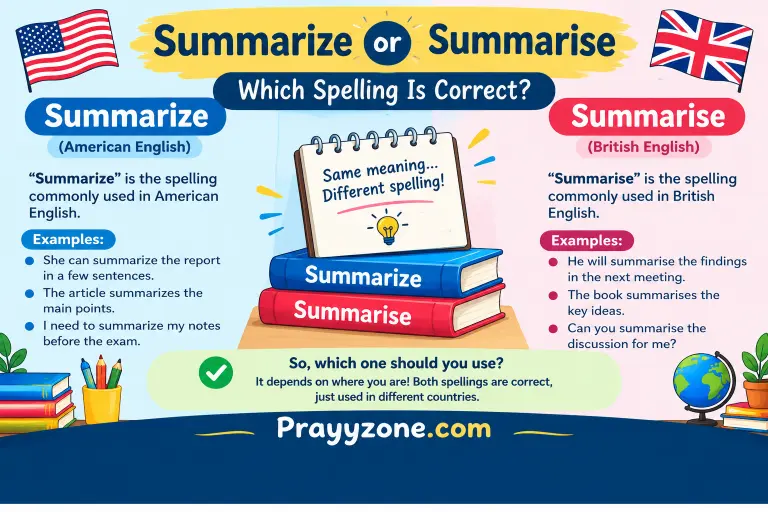
“Summarize or Summarise are two spellings of the same word. “Summarize” is the preferred spelling in American English, while “summarise” is more common in British English. Both mean to give a brief explanation of the main points of a text, article, or topic without including unnecessary details”.
English can be confusing when the same word has two spellings. Summarize or summarise is a common example. Both words have the same meaning, but the spelling depends on the type of English you use. If you write for an American audience, you will usually see summarize. If you write in British English, you will usually see summarise. Cambridge lists summarise as the usual UK form, while summarize is the standard form shown for US English.
People often search for “summarize or summarise” because they want to know which spelling is correct for school, work, websites, or professional writing. The good news is simple: both spellings are correct. The main difference is regional spelling style, not meaning.
This guide explains the history behind the two forms, compares British and American usage, and gives clear examples. It also explains which spelling to choose for different audiences. By the end, you will know when to use summarize, when to use summarise, and how to keep your writing consistent.
Summarize or Summarise – Quick Answer
Summarize and summarise mean the same thing: to give the main points of something in a short and clear way.
- Summarize → American English
- Summarise → British English and common British-style usage
Examples
American English:
Please summarize the report.
British English:
Please summarise the report.
The meaning does not change. Only the spelling changes. Cambridge defines the verb as expressing the most important facts or ideas in a short and clear form.
| Variation | Main spelling style | Example |
| summarize | American English | Please summarize the article. |
| summarise | British English | Please summarise the article. |
| summarized | American English | She summarized the report. |
| summarised | British English | She summarised the report. |
| summarizing | American English | He is summarizing the meeting. |
| summarising | British English | He is summarising the meeting. |
The Origin of Summarize or Summarise
The word comes from summary, which is related to the Latin summa, meaning the whole, total, or main substance of something. The verb summarize appeared in English in the 19th century. Etymonline dates the verb to 1837, formed from summary plus the suffix -ize.
The spelling summarise developed as the British form of the same verb. The difference is part of a wider English spelling pattern involving -ize and -ise.
For example:
- organize / organise
- recognize / recognise
- realize / realise
- apologize / apologise
- summarize / summarise
American English generally uses -ize in these words. British English commonly uses -ise. The NCBI Style Guide lists summarise as British and summarize as American.
However, British spelling is not always completely uniform. Some British dictionaries and style guides accept or use -ize forms. So it is better to think of summarise as a common British preference rather than claiming that every British writer must use it.
British English vs American English Spelling
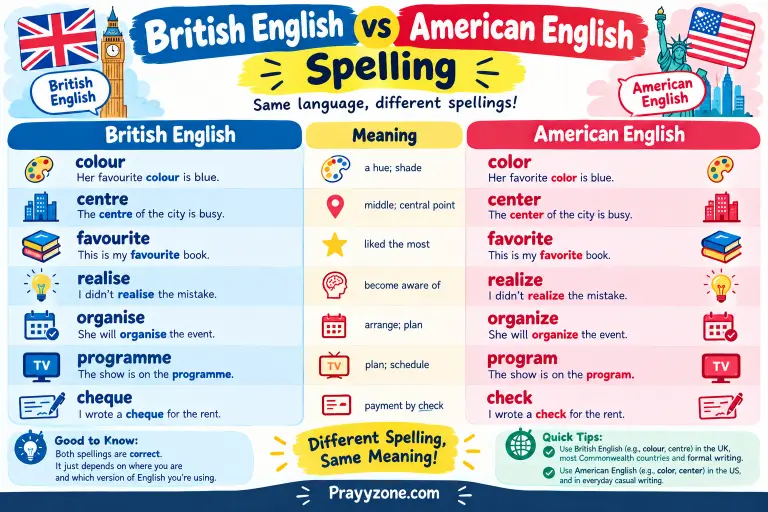
The biggest difference is the letter s versus z.
American English
American English normally uses:
summarize
Other forms include:
- summarized
- summarizing
- summarization
British English
British English commonly uses:
summarise
Other forms include:
- summarised
- summarising
- summarisation
The pronunciation and meaning remain essentially the same.
Comparison Table
| Feature | American English | British English |
| Verb | summarize | summarise |
| Past tense | summarized | summarised |
| -ing form | summarizing | summarising |
| Noun | summarization | summarisation |
| Main spelling pattern | -ize | -ise |
| Example | Summarize the report. | Summarise the report. |
The same regional pattern appears in many other words.
Which Spelling Should You Use?
Choose your spelling based on your audience.
For a US Audience
Use summarize when writing for:
- American schools
- US companies
- American websites
- US academic work
- American publications
Example:
The final section summarizes the main findings.
For a UK or Commonwealth Audience
Use summarise when following British-style English.
Example:
The final section summarises the main findings.
This style is common in the UK and in many contexts influenced by British English.
For a Global Audience
If your audience is international, either form can work. The most important rule is consistency.
If you start with summarize, continue using related American spellings. If you choose summarise, keep the British style throughout the document.
Do not switch between the two without a reason.
Common Mistakes with Summarize or Summarise
1. Thinking One Spelling Is Wrong
Both forms are legitimate.
Wrong idea:
Summarise is always incorrect.
Correct:
Summarise is a standard British-style spelling.
2. Mixing Spellings
Avoid using both forms in the same document.
Inconsistent:
The first chapter summarizes the study. The next chapter summarises the results.
Choose one style and keep it consistent.
3. Using the Wrong Past Tense
American English:
She summarized the article.
British English:
She summarised the article.
4. Forgetting the Double M
The correct forms contain two m letters:
- summarize
- summarise
- summarized
- summarised
Not:
- sumarize
- sumarise
5. Confusing Summary and Summarize
Summary is usually a noun.
I wrote a summary of the book.
Summarize/summarise is a verb.
I will summarize the book.
Summarize or Summarise in Everyday Examples
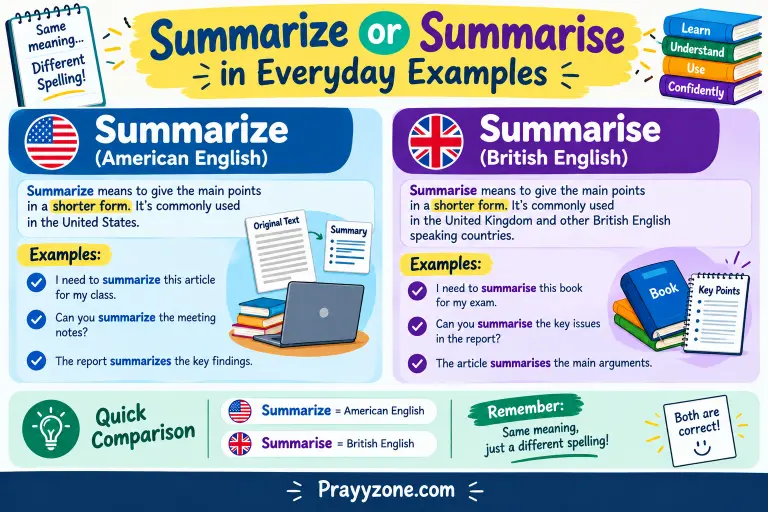
In Emails
US style:
Could you summarize the main points from today’s meeting?
UK style:
Could you summarise the main points from today’s meeting?
In News Writing
US style:
The article summarizes the latest developments.
UK style:
The article summarises the latest developments.
On Social Media
US style:
Can someone summarize this thread?
UK style:
Can someone summarise this discussion?
In Formal Writing
US style:
This section summarizes the research findings.
UK style:
This section summarises the research findings.
In Academic Writing
The verb is useful when you need to present the main ideas of a source briefly. Academic guidance also distinguishes summarizing from paraphrasing: a summary is normally much shorter than the original material.
Summarize or Summarise – Google Trends & Usage Data
Search interest for summarize or summarise reflects the wider difference between American and British spelling. The two forms are not competing words with different meanings. They are regional spellings of the same verb.
In general:
- Summarize is strongly associated with US English.
- Summarise is strongly associated with British English.
- British-style usage is also found in countries and institutions that follow British spelling conventions.
- Search interest can change based on education, academic writing, software, publishing, and regional language habits.
It is important not to treat search volume as a measure of correctness. A word can have more searches simply because more people use that spelling or because search engines and software expose users to that form.
Dictionary evidence supports the regional distinction. Cambridge labels summarise as the usual UK form, while Merriam-Webster identifies summarise as the British spelling of summarize.
For content, the best approach is usually to match the spelling used by your target audience. If your website targets US readers, summarize is the natural choice. If it targets UK readers, summarise may fit better.
Summarize vs Summarise: Comparison Table
| Word | Meaning | Main Usage | Example |
| summarize | Give the main points briefly | American English | Summarize the report. |
| summarise | Give the main points briefly | British English | Summarise the report. |
| summarized | Past form of summarize | American English | She summarized the book. |
| summarised | Past form of summarise | British English | She summarised the book. |
| summarizing | -ing form of summarize | American English | He is summarizing the data. |
| summarising | -ing form of summarise | British English | He is summarising the data. |
| summary | A short account of the main points | Both | Read the summary first. |
FAQs About Summarize or Summarise
1. Is summarize or summarise correct?
Both are correct. Summarize is the standard American spelling, while summarise is commonly used in British English.
2. Is summarize American English?
Yes. Summarize is the standard spelling used in American English.
3. Is summarise British English?
Yes. Summarise is commonly used in British English. Cambridge lists it as the usual UK form.
4. Do summarize and summarise have different meanings?
No. They have the same basic meaning: to give the main points of something briefly.
5. Which spelling should I use in the US?
Use summarize for American English.
6. Which spelling should I use in the UK?
Use summarise if you are following the common British spelling style.
7. Can I use summarize in British English?
Yes. British English has some variation in -ize/-ise spellings. However, summarise is a common British form, so use it when you want a clearly British style.
8. Is summarized or summarised correct?
Both are correct.
- American English: summarized
- British English: summarised
Conclusion
When choosing between summarize or summarise, the simple answer is that both spellings are correct. The difference is mainly regional. Summarize is the standard American English form, while summarise is commonly used in British English. The meaning stays the same: both mean to give the main points of something in a short and clear way.
For US readers, choose summarize, summarized, and summarizing. For British-style writing, choose summarise, summarised, and summarising. The most important point is to stay consistent throughout your writing.
This small spelling difference matters most in professional, academic, and content writing because matching your audience’s English style makes your content look polished. You do not need to worry about one form being universally correct. Instead, identify your audience and follow its spelling convention.
In short, remember this easy rule: US English uses summarize; British English commonly uses summarise. Once you know that, the choice becomes simple.
Read More Articles:
- Hes or He’s: Which One Is Correct?
- Steelers or Ravens: Which NFL Team Is Better?
- Coarse or Course: Which Spelling Is Correct?