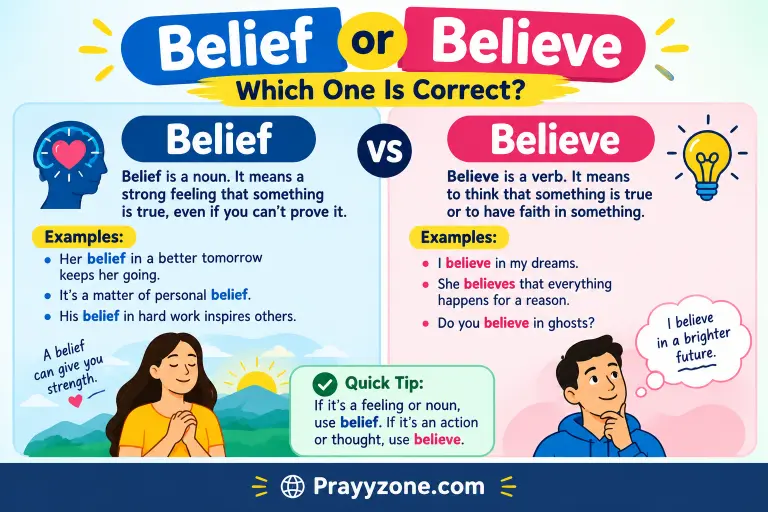
”Belief and believe are both correct words, but they have different grammatical uses. Belief is a noun meaning an idea or opinion that someone accepts as true, while believe is a verb meaning to accept something as true or have confidence in it. For example, “Her belief in herself is strong,” while “I believe you.”
Have you ever stopped while writing and wondered if you should use belief or believe? You are not alone. These two words look and sound very similar, but they do different jobs in a sentence. Choosing the wrong one can make an otherwise good sentence grammatically incorrect.
The quick answer is simple: belief is usually a noun, while believe is a verb. For example, “Her belief is strong” uses belief as a thing or idea. “I believe her” uses believe as an action or state of mind.
People often search for “belief or believe” because the words share the same root and are easy to mix up. This is especially common for English learners, students, bloggers, and anyone writing professional English.
This guide explains the difference between belief and believe, their history, common mistakes, everyday examples, spelling rules, and usage trends. By the end, you will know exactly which word to use and why.
Belief or Believe – Quick Answer
Belief is a noun. It means an idea, opinion, or feeling that something is true.
Believe is a verb. It means to accept something as true or to have confidence in someone or something.
| Word | Part of speech | Meaning | Example |
| belief | Noun | An idea accepted as true | Her belief in the plan was strong. |
| believe | Verb | To accept something as true | I believe your story. |
Easy rule
Think:
- Belief = a thing you have
- Believe = something you do
For example:
I believe in my team.
My belief in my team is strong.
Both sentences are correct, but the grammar is different.
The Origin of Belief or Believe
The two words are closely related. Their history goes back to Old English and earlier Germanic forms connected with ideas such as trust, confidence, and holding something dear.
Believe developed from Middle English bileven and Old English forms related to having faith or confidence. Belief appeared in Middle English as bileave.
Over time, the spelling and meanings became more settled. The modern distinction between the final -f in belief and -ve in believe developed during the Middle English period.
This shared history explains why the words look so similar today.
The important point is that belief is not simply an alternative spelling of believe. They became separate words with different grammatical functions.
For example:
- I believe you. → verb
- I have a belief. → noun
British English vs American English Spelling
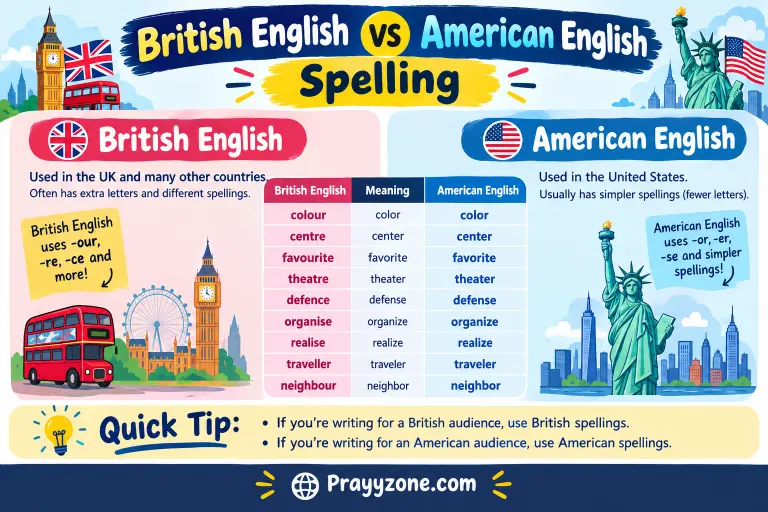
Unlike words such as colour/color or favour/favor, belief and believe do not have different standard British and American spellings.
Both British English and American English use:
- belief
- believe
The main difference is not regional spelling. It is grammar and meaning. Collins lists belief as a noun in both British and American English, while believe functions as the related verb.
| English variety | Noun | Verb | Example |
| British English | belief | believe | I believe you. |
| American English | belief | believe | I believe you. |
| Canadian English | belief | believe | I believe you. |
| Australian English | belief | believe | I believe you. |
| International English | belief | believe | I believe you. |
So, you do not need to change belief to another spelling when writing for a US or UK audience.
Which Spelling Should You Use?
The answer depends on what you want to say.
Use “believe” when you need a verb
Use believe when someone accepts something as true or has confidence in something.
Examples:
- I believe you.
- They believe the report.
- We believe in our team.
- She believes that the plan will work.
Use “belief” when you need a noun
Use belief when you are talking about an idea, opinion, or conviction.
Examples:
- His belief was strong.
- Her belief in education is clear.
- They share the same belief.
- This is an important belief for many people.
Advice for global writers
If your audience includes readers from the US, UK, Canada, Australia, or other English-speaking countries, you can use the same spellings.
Focus on grammar, not regional spelling.
Common Mistakes with Belief or Believe
Because the words are closely related, several mistakes are common.
Mistake 1: Using “belief” as a verb
Incorrect:
I belief you.
Correct:
I believe you.
Mistake 2: Using “believe” as a noun
Incorrect:
My believe is that it will work.
Correct:
My belief is that it will work.
Mistake 3: Confusing “believes” and “beliefs”
These are different forms.
- Believes = verb
- Beliefs = plural noun
Examples:
She believes the story.
Their beliefs are different.
Mistake 4: Confusing “believed” and “belief”
Believed is a past-tense verb.
Belief is a noun.
Examples:
I believed him yesterday.
My belief in him remains strong.
Spelling tip
Remember the basic forms:
believe → believed → believing
belief → beliefs
A useful memory trick for believe is to notice the letters lie inside it:
be-LIE-ve
This can help you remember the ie order.
Belief or Believe in Everyday Examples

These words appear often in everyday English.
In emails
Believe:
I believe the attached information is correct.
Belief:
It is my belief that we should review the plan.
The first uses a verb. The second uses a noun.
In news writing
News reports may use both words:
Officials believe the new policy will have an effect.
There is growing belief that the policy may change.
In social media
People often use believe in short personal statements:
I believe in you!
They may use belief when discussing ideas:
Strong belief can influence how people make decisions.
In formal writing
Both words are useful in academic and professional writing:
Researchers believe that the results require further study.
The belief that all evidence should be reviewed is important to good research.
Belief or Believe – Google Trends & Usage Data
Google Trends is useful for studying how often people search for terms over time and across regions. However, it is important to understand what its numbers mean.
Google Trends uses relative interest, not a simple count of every search. A score of 100 represents the highest relative interest for the selected comparison and period; other scores are scaled against it.
For belief vs. believe, search interest can be affected by the fact that the words have different meanings. Someone searching for believe may be looking for grammar help, definitions, phrases, or general information. Someone searching for belief may be interested in ideas, opinions, religion, philosophy, or vocabulary.
Therefore, a Trends comparison should not be treated as a direct measurement of how many people use each word in everyday speech.
Google Trends can compare terms across countries and over long periods, making it useful for studying regional and historical search behavior.
What this means for content
For content creators, both terms can have value, but the search intent is different.
| Search term | Likely intent | Content focus |
| belief or believe | Grammar confusion | Difference and examples |
| belief meaning | Definition | Noun meaning |
| believe meaning | Definition | Verb meaning |
| believe in meaning | Phrase meaning | Usage and examples |
| belief vs believe | Comparison | Grammar guide |
For content, it is better to create content that answers the user’s actual question rather than treating the two words as spelling alternatives.
Belief or Believe – Comparison Table
| Feature | Belief | Believe |
| Part of speech | Noun | Verb |
| Main meaning | An idea accepted as true | To accept something as true |
| Plural/present form | beliefs | believes |
| Past form | — | believed |
| -ing form | — | believing |
| Example | His belief is strong. | I believe him. |
| Correct spelling | Yes | Yes |
| British spelling | belief | believe |
| American spelling | belief | believe |
FAQs About Belief or Believe
1. Is it belief or believe?
Both are correct. Belief is a noun, while believe is a verb.
2. What is the difference between belief and believe?
Belief describes an idea, opinion, or conviction. Believe describes the act or state of accepting something as true.
3. Is “I belief you” correct?
No. The correct sentence is:
I believe you.
4. Is “my believe” correct?
Usually, no. When you mean an idea or opinion, use belief:
My belief is that the plan will work.
5. Is belief British or American English?
Both British and American English use belief. There is no standard regional spelling difference.
6. Is believe British or American English?
Both varieties use believe. The spelling is the same in British and American English.
7. How can I remember the difference?
Remember:
Believe = verb
Belief = noun
You can also remember that be-LIE-ve contains “lie,” which helps recall the spelling of believe.
Conclusion: Belief or Believe?
Understanding belief or believe is easier once you focus on grammar. Both words are correct, but they are not interchangeable. Believe is a verb used for accepting something as true, trusting someone, or having confidence in something. Belief is a noun used for an idea, opinion, conviction, or accepted truth.
The words are closely related because they share a long linguistic history. However, modern English gives them different jobs in a sentence. This is true in both British and American English, so you do not need to choose a regional spelling.
For everyday writing, remember one simple rule: you believe something, but you have a belief. For example, “I believe the story” and “My belief is strong” are both correct.
Once you learn this difference, you can avoid common errors such as “I belief you” or “my believe.” Use believe for the verb and belief for the noun, and your writing will be clear and professional.
Read More Articles
- Civic or Corolla: Which Car Name and Spelling Is Correct?
- Telegram or Signal: Which Messaging App Should You Choose?
- Bitwise OR Calculator: A Simple Guide With Examples