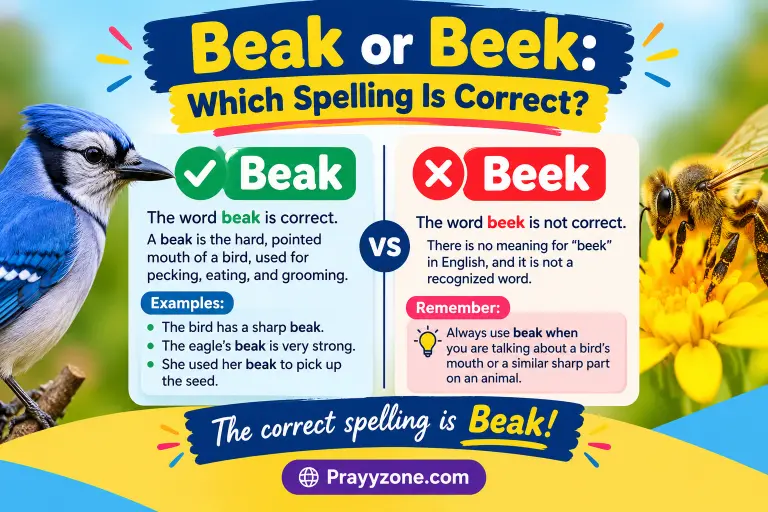
”Beak is the correct and standard English spelling for the hard, pointed mouth of a bird. Beek is generally not a standard English spelling for this meaning and is usually considered a misspelling. For example, “The eagle has a sharp beak” is correct.”
Have you ever heard the word “beak” and wondered if it should be spelled “beek”? You are not alone. The two spellings look and sound very similar, so English learners often search for “beak or beek” when they want to check the correct spelling.
The answer is simple for most everyday English: beak is the standard spelling for the hard, pointed part of a bird’s mouth. For example, we say, “The eagle has a sharp beak.” Major dictionaries such as Cambridge and Oxford list beak with this meaning.
However, beek is also a real, rare word in some dictionaries. It can be a Scottish or Northern English verb meaning to warm or bask.
This guide explains the difference between beak and beek, their origins, British and American usage, common mistakes, examples, and practical advice on which spelling to choose.
Beak or Beek – Quick Answer
For normal English, especially when talking about a bird’s mouth, use beak.
- Beak = the hard, pointed or curved mouth of a bird.
- Beek = a rare regional word, not the normal spelling of beak.
Examples
Correct:
The parrot has a strong beak.
Correct:
The bird used its beak to pick up food.
Usually incorrect if you mean a bird’s mouth:
The parrot has a strong beek.
Cambridge defines beak as the hard, pointed part of a bird’s mouth.
So, if you are writing an email, school assignment, article, or general website content about birds, beak is the word you should use.
The Origin of Beak
The word beak has a long history. Oxford traces it through Middle English from Old French bec, ultimately from Latin beccus, with Celtic roots. Merriam-Webster records its first known use in English in the 13th century.
Over time, beak became the standard English spelling for a bird’s bill or mouth.
The spelling beek has a different history. Collins records beek as a chiefly Scottish and Northern English word meaning to bask or warm oneself. Merriam-Webster also lists it as a chiefly Scottish verb meaning “warm” or “bask.”
This is why the two words should not always be treated as simple spelling variants. They can have different meanings and different histories.
Why does the confusion happen?
The main reason is pronunciation. Beak is pronounced with a long “ee” sound in many varieties of English, so learners may naturally think it should be spelled beek.
English spelling does not always match pronunciation. This creates many spelling questions, including this one.
British English vs American English Spelling
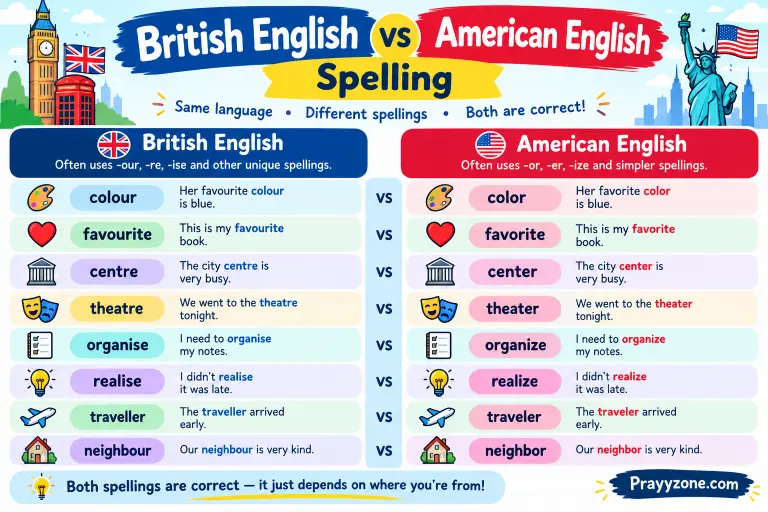
There is no normal British-versus-American spelling change from beak to beek.
Both British and American English use beak for a bird’s mouth. Cambridge gives the word in both varieties, while Oxford also lists beak as the standard word.
| Feature | British English | American English |
| Bird’s mouth | beak | beak |
| Common pronunciation | /biːk/ | /biːk/ |
| “Beek” as bird’s mouth | Not standard | Not standard |
| Regional “beek” | Exists in some Scottish/Northern usage | Not standard for a bird’s mouth |
| Formal writing | beak | beak |
This differs from words such as colour/color, where British and American spelling can change.
With beak, the spelling stays the same.
Which Spelling Should You Use?
For US readers
Use beak when you mean a bird’s mouth.
Example:
The hummingbird has a long beak.
For UK readers
Use beak for a bird’s mouth.
Example:
The robin cleaned its beak.
The word beek can occur in regional British usage, but it has a different meaning. It should not normally replace beak.
For Commonwealth readers
For countries such as Canada, Australia, and New Zealand, beak is the safe standard choice when referring to a bird’s mouth.
Choose beak.
It is clear, familiar, and accepted in standard English.
Common Mistakes with Beak or Beek
Mistake 1: Writing “beek” because of pronunciation
Incorrect for a bird’s mouth:
The duck has a yellow beek.
Correct:
The duck has a yellow beak.
Mistake 2: Thinking “beek” is the British spelling
British English does not normally use beek as an alternative spelling of beak.
Correct:
The bird has a large beak.
Mistake 3: Treating every dictionary entry as the same meaning
Beek does appear in dictionaries, but its regional meaning is different. Collins and Merriam-Webster record it as a Scottish or regional word connected with warming or basking.
Mistake 4: Using “beek” in school or professional writing
If you mean a bird’s mouth, use beak.
This avoids confusion and follows standard modern English usage.
Beak or Beek in Everyday Examples
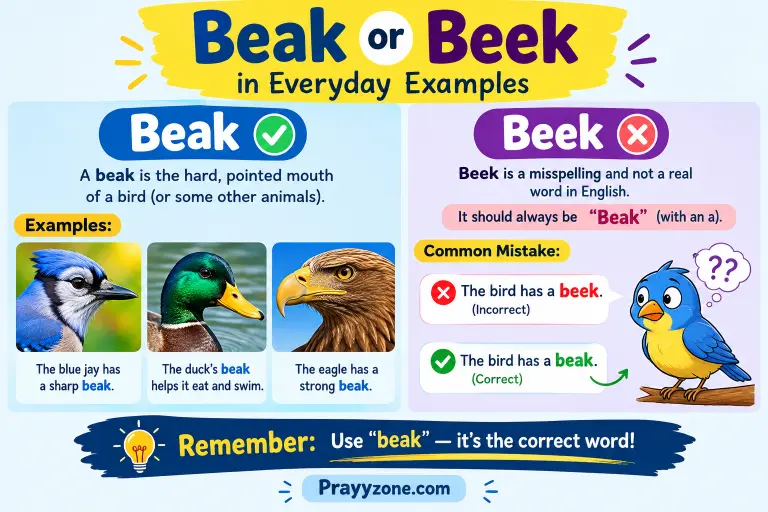
In Emails
Correct:
The injured bird needs care because its beak is damaged.
In News Writing
Correct:
The bird uses its strong beak to find food.
On Social Media
Correct:
Look at that funny little beak!
In Formal Writing
Correct:
The shape of a bird’s beak can help it obtain different types of food.
In Science
Correct:
Scientists can study the structure of a bird’s beak to understand how it feeds.
When “beek” may be correct
In a regional or historical context, beek can have its own meaning related to warming or basking.
For example, a dictionary may record beek as a Scottish verb meaning to warm oneself.
Therefore, context matters.
Beak or Beek – Google Trends & Usage Data
Searches for “beak or beek” usually show a spelling question: people want to know which form they should use.
For practical content, the key distinction is:
- Beak is the common standard word for a bird’s mouth.
- Beek is much less common and has regional dictionary meanings.
- Searchers may type beek because the pronunciation of beak contains a long “ee” sound.
- Users may also encounter beek in older, regional, or specialized sources.
A precise Google Trends number should be checked directly in Google Trends for a selected country and date range. Search interest changes over time, so fixed percentages or rankings should not be presented without a current Trends query.
For general content writing, the main target should be beak, while beak or beek can work well as a question-based keyword.
Beak vs Beek – Comparison Table
| Variation | Standard word? | Main meaning | Best use |
| beak | Yes | Bird’s mouth | Everyday and formal English |
| beek | Yes, but rare/regional | To warm or bask | Regional/historical contexts |
| beak or beek | Search phrase | Spelling/meaning question | content and educational content |
The important point is that beek is not simply a misspelling in every case. It is a real but uncommon word with regional meanings.
FAQs
1. Is “beak” or “beek” correct?
Beak is correct when you mean the hard mouth of a bird.
2. Is “beek” a real English word?
Yes. Dictionaries record beek as a rare regional word, especially in Scottish and Northern English usage.
3. Is “beek” the British spelling of “beak”?
No. Beak is the normal British spelling for a bird’s mouth.
4. How do you spell the mouth of a bird?
Spell it beak.
5. How do you pronounce “beak”?
It is commonly pronounced with a long “ee” sound, like the vowel sound in “week.” Cambridge gives the British pronunciation as /biːk/.
6. What does “beak” mean?
Most commonly, beak means the hard pointed or curved outer part of a bird’s mouth. It can also have other meanings, including informal uses for a person’s nose and some older British slang meanings.
7. Should I use “beak” in formal writing?
Yes. If you are talking about a bird’s mouth, beak is the standard choice for formal and professional writing.
Conclusion
The answer to “beak or beek” depends on what you mean, but the choice is easy in most situations. When you are talking about a bird’s mouth, beak is the standard English word. It is used in both British and American English, so there is no special US or UK spelling to learn.
Beek is different. It is a real but uncommon regional word. Dictionaries such as Collins and Merriam-Webster record it mainly in Scottish or related regional usage, where it can mean to warm or bask.
The pronunciation of beak can cause spelling confusion because it contains a long “ee” sound. This may lead learners to write beek, even when they mean the bird’s mouth.
For schoolwork, websites, emails, news, and professional writing, remember one simple rule: bird’s mouth = beak. Use beek only when the context specifically calls for its rare regional meaning.