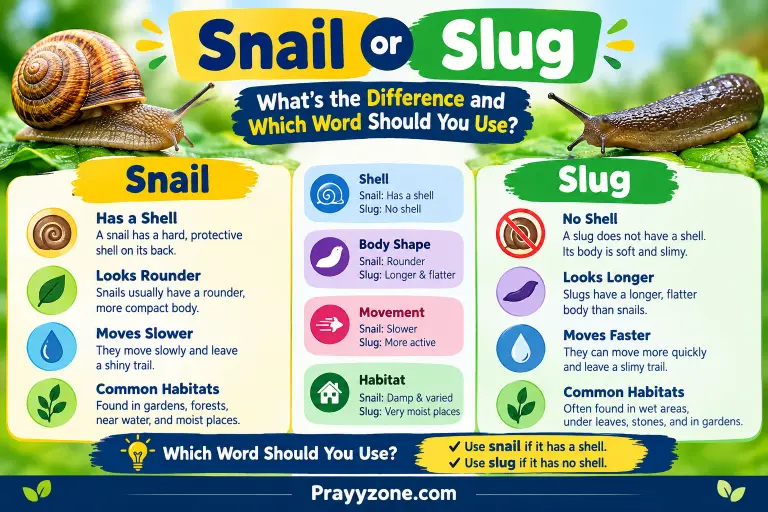
”Snails and slugs are both soft-bodied gastropods, but the main difference is their shell. A snail has a visible external shell, while a slug has no large external shell. Use snail when referring to the shelled animal and slug for the shell-less form. For example, “A snail moved slowly across the leaf,” while “A slug was found in the garden.”
Have you ever seen a small, slow-moving animal in your garden and wondered, “Is it a snail or slug?” You are not alone. These two words are often confused because snails and slugs are closely related animals. Both belong to a large group of soft-bodied animals called gastropods, and both can be found in gardens, forests, fields, and other damp places.
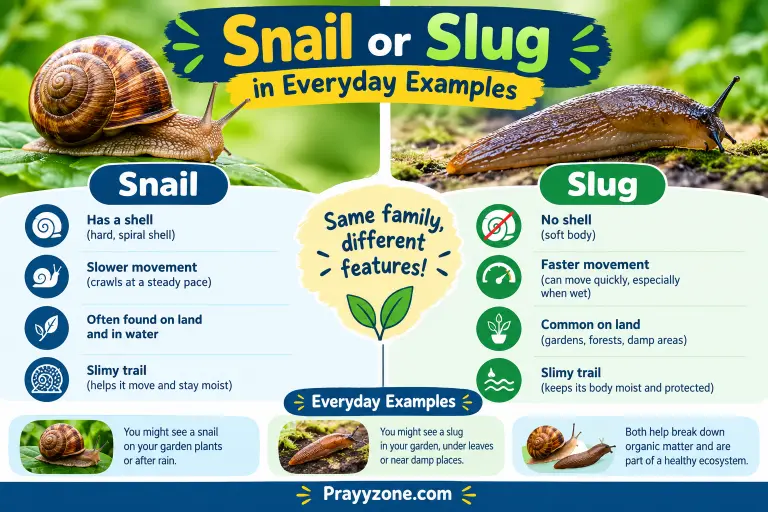
The main difference is easy to remember. A snail usually has a visible shell, while a slug does not have an external shell. Some slugs have a small internal shell, but you will not see a large spiral shell like the one on most land snails.
People search for “snail or slug” to learn how to tell these animals apart, understand their names, and use the right word in writing. This guide gives a simple answer first, then explains the terms, common mistakes, everyday examples, and usage trends. By the end, you will know exactly when to use snail and when to use slug.
Snail or Slug – Quick Answer
Snail and slug are different names for closely related gastropods.
- Snail: Usually has a visible external shell.
- Slug: Usually has no visible external shell.
- Snail example: “A snail was moving across the garden path.”
- Slug example: “A slug was eating the leaves.”
The shell is the easiest feature to use when identifying them.
| Feature | Snail | Slug |
| External shell | Usually yes | Usually no |
| Body | Soft and flexible | Soft and flexible |
| Movement | Slow | Slow |
| Habitat | Gardens, forests, water | Gardens, forests, damp areas |
| Common food | Plants and other organic matter | Plants and other organic matter |
The Origin of Snail or Slug
The word snail has a long history in English. It comes from Old English snægl, a word used for a snail or similar shell-bearing creature.
The word slug also has Old English roots. It developed from words connected with slow-moving, slimy, or crawling creatures.
These words describe animals rather than spelling variations of the same word. Therefore, snail and slug are not British and American spelling differences.
For example:
- British English: snail
- American English: snail
- British English: slug
- American English: slug
The spelling stays the same across major forms of English.
British English vs American English Spelling
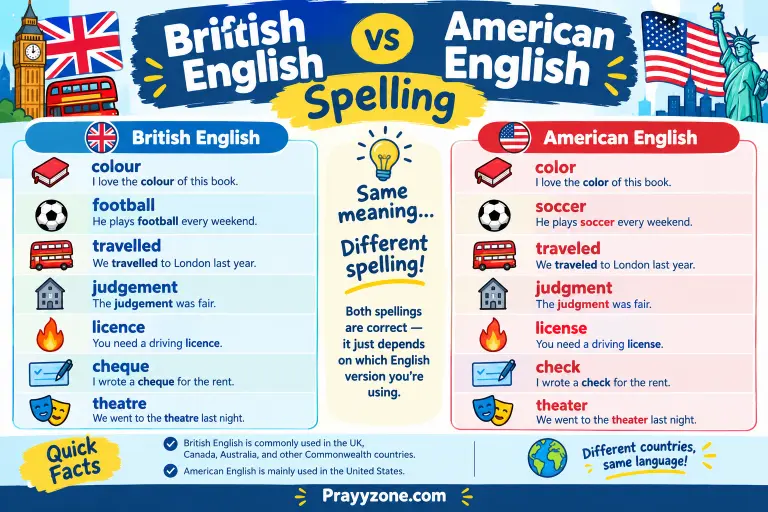
There is no major spelling difference between British and American English for snail or slug.
Both forms use:
- snail
- slugs
- slug
- snails
| Meaning | British English | American English |
| One shell-bearing gastropod | snail | snail |
| More than one | snails | snails |
| One shell-less gastropod | slug | slug |
| More than one | slugs | slugs |
Other words may have different British and American spellings, such as colour/color and centre/center. However, snail and slug do not follow that pattern.
Which Spelling Should You Use?
The answer depends on what animal you mean, not where your readers live.
For US readers
Use snail when the animal has a visible shell. Use slug when it does not have an obvious external shell.
For UK and Commonwealth readers
Use the same spellings. British English does not change snail or slug.
For a global audience
Use the standard forms:
- snail
- slug
These words are widely understood around the world.
If you are writing about a specific species, use its accepted scientific or common name when possible. This can avoid confusion because some animals have unusual shell structures.
Common Mistakes with Snail or Slug
Mistake 1: Treating the words as synonyms
Incorrect: “A snail is another word for a slug.”
Correct: “Snails and slugs are closely related, but they are not the same.”
Mistake 2: Thinking every slug has absolutely no shell
Most familiar slugs do not have an obvious external shell. However, some slug groups have reduced or internal shell structures.
Mistake 3: Assuming the spelling changes by country
Incorrect: “Slugg is the American spelling.”
Correct: slug is the standard spelling in both British and American English.
Mistake 4: Using “snail” for every garden gastropod
Not every small, slimy garden gastropod is a snail. Look for a visible shell before choosing the word.
Snail or Slug in Everyday Examples
In an Email
“I noticed several snails near the plants after the rain.”
In News Writing
“Gardeners reported an increase in slugs following several wet days.”
On Social Media
“Look at this tiny snail I found in the garden!”
In Formal Writing
“Snails and slugs can play important roles in many ecosystems.”
In School Writing
“The snail moved slowly across the leaf.”
In General Conversation
“Is that a snail or a slug?”
The wording should match what you are describing.
Snail or Slug – Comparison Table
| Variation | Meaning | Correct Use |
| snail | Usually a gastropod with an external shell | “I found a snail.” |
| snails | More than one snail | “The snails were near the plants.” |
| slug | Usually a gastropod without a visible external shell | “A slug crossed the path.” |
| slugs | More than one slug | “The slugs damaged the leaves.” |
| snail or slug | A question about identification | “Is it a snail or slug?” |
| snails and slugs | Refers to both groups | “Snails and slugs are gastropods.” |
Snail or Slug – Google Trends & Usage Data
Search interest for “snail” and “slug” can change by country, season, and context.
People often search these terms when:
- They find one in a garden.
- They want to identify an animal.
- They are learning about nature.
- They are dealing with garden pests.
- They are studying biology.
- They want to compare snails and slugs.
Search interest can also rise during wet weather, when these animals are more noticeable.
The exact popularity of each term can vary by country and time. Google Trends measures relative search interest rather than showing the total number of searches. It is therefore best used to compare patterns, not to treat its numbers as exact search volumes.
For content, phrases such as “snail or slug,” “snail vs slug,” “difference between snail and slug,” and “is it a snail or slug” can match different search intents.
FAQs About Snail or Slug
1. What is the main difference between a snail and a slug?
The easiest difference is the shell. Snails usually have a visible external shell, while slugs usually do not.
2. Are snails and slugs related?
Yes. Both are gastropods and are closely related.
3. Can a slug have a shell?
Some slugs have reduced or internal shell structures. However, they usually do not have the large external shell associated with common snails.
4. Is “snail” a British or American spelling?
Snail is correct in both British and American English.
5. Is “slug” a British or American spelling?
Slug is also correct in both British and American English.
6. Which is faster, a snail or a slug?
Both are generally slow-moving animals. Speed varies by species and conditions, so there is no simple rule that one is always faster.
7. How can I tell if I found a snail or slug?
Look for a visible external shell. If there is one, it is likely a snail. If there is no obvious external shell, it is likely a slug.
Conclusion
Understanding snail or slug is simple once you know the main difference. A snail usually has a visible external shell, while a slug usually does not. Both animals are soft-bodied gastropods, and they can live in many of the same environments. They may also appear in gardens, especially in damp conditions.
There is no British-versus-American spelling problem with these words. Snail is spelled the same in both forms of English, and slug is also spelled the same. The important issue is choosing the word that matches the animal you mean.
For everyday writing, use snail for a shell-bearing animal and slug for one without an obvious external shell. If you are writing about a specific species, a scientific name can provide greater accuracy. if you are answering a school question, writing an article, or describing something you found outdoors, these simple rules will help you choose the right word.