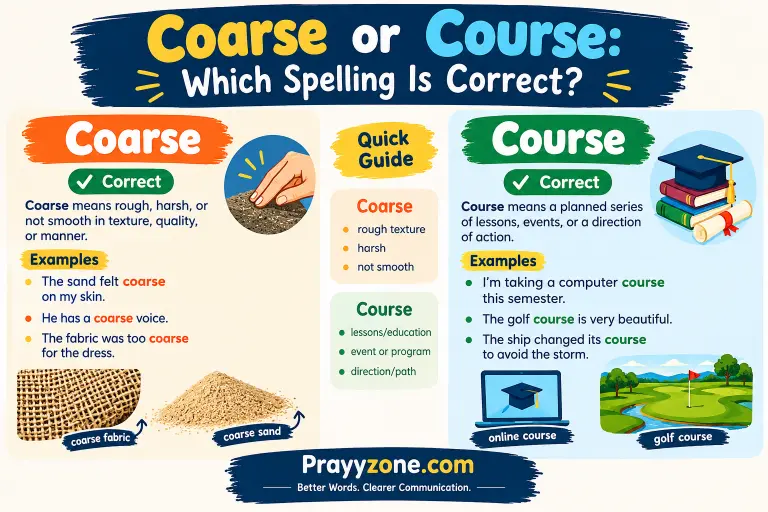
”Coarse and course are both correct words, but they have different meanings. Coarse means rough, harsh, or made of large particles, while course can mean a class, direction, route, or part of a meal. For example, “The fabric feels coarse,” while “I enrolled in an English course.”
Have you ever stopped while writing and wondered if the correct word is coarse or course? You are not alone. These two words sound the same, but they have different meanings and uses. This makes them easy to mix up in emails, schoolwork, social media posts, and formal writing.
The good news is that the difference is simple. Coarse is usually an adjective that describes something rough, large, or not refined. For example, you can have coarse sand, coarse fabric, or coarse language. Course is mainly a noun or verb. It can mean a class, a route, a direction, or a process. For example, you can take a course or change the course of a river.
This guide explains coarse or course, their meanings, origins, spelling, and common mistakes. You will also see simple examples and tips to help you choose the right word every time.
Coarse or Course – Quick Answer
Coarse and course are both correct words, but they do not mean the same thing.
| Word | Meaning | Example |
| coarse | Rough, large, crude, or unrefined | The fabric feels coarse. |
| course | A class, route, direction, process, or part of a meal | I signed up for a writing course. |
Both words are pronounced the same in standard English, making them homophones. Their meanings depend on spelling and context.
Use coarse when you mean:
- Rough in texture
- Made of large pieces
- Crude or unrefined
- Rude or offensive
Examples:
- The beach had coarse sand.
- The sweater was made from coarse wool.
- His coarse language was inappropriate.
Use course when you mean:
- A class or program of study
- A route or direction
- A process or series of events
- A part of a meal
- To move quickly, as a verb
Examples:
- She enrolled in a computer course.
- The ship changed course.
- We ate the main course first.
- Water coursed through the channel.
The Origin of Coarse or Course
The two words have a close historical connection, which helps explain why their spellings and sounds are so similar.
Course comes from Middle English cours. It was borrowed from Anglo-French and ultimately comes from Latin cursus, meaning movement, running, journey, or direction. The Latin word comes from currere, meaning “to run.”
Coarse has a less certain history. Merriam-Webster traces it to Middle English cors and says it may have developed from course. Oxford also notes that the origin is uncertain and that the two words were identical in spelling until around the 17th century.
Over time, coarse developed meanings linked to ordinary or inferior quality, rough texture, and later rude or crude behavior. Course kept its meanings connected with movement, direction, study, and progression.
This history helps explain why two words can sound alike while having different modern spellings and meanings.
British English vs American English Spelling
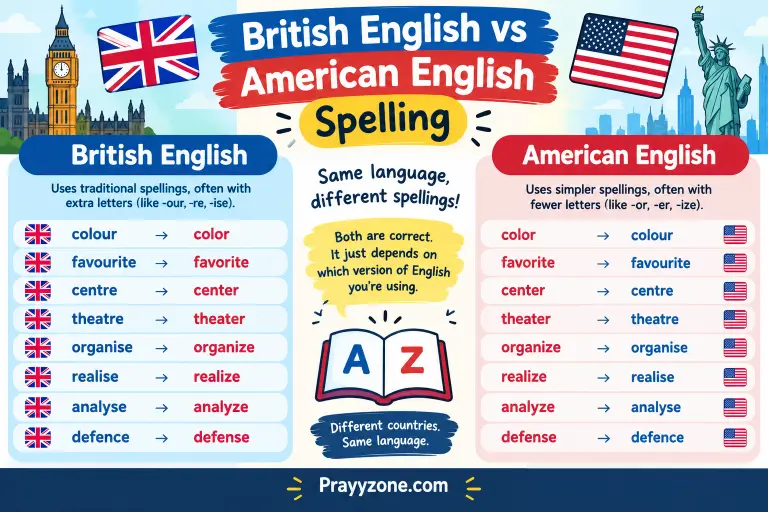
There is no major British-versus-American spelling difference between coarse and course. Both varieties of English normally use the same spellings.
The main difference is not spelling. It is how the words may appear in different contexts.
| Meaning | British English | American English |
| Rough texture | coarse | coarse |
| A class | course | course |
| A route | course | course |
| Part of a meal | course | course |
| Rude or crude | coarse | coarse |
Examples
British English:
- She is taking an English course.
- The material feels coarse.
American English:
- She is taking an English course.
- The material feels coarse.
So, unlike words such as colour/color or centre/center, coarse and course do not change spelling between British and American English.
Which Spelling Should You Use?
Your choice depends on what you want to say, not where you live.
Use coarse for texture or quality
Choose coarse when you describe something rough, large-grained, crude, or unrefined.
The sand is coarse.
The artist used coarse paper.
Use course for education
Choose course when talking about classes or programs.
I am taking a business course.
Use course for direction or progress
Use course for a route, direction, or process.
The plane changed its course.
The project is on course.
For international writing, the same basic rule works everywhere: coarse describes; course directs, teaches, or progresses.
Common Mistakes with Coarse or Course
Because the words sound alike, spelling errors are common.
Mistake 1: “I am taking a coarse.”
❌ Incorrect:
I am taking a coarse in English.
✅ Correct:
I am taking a course in English.
A class or program is a course.
Mistake 2: “The sand is course.”
❌ Incorrect:
The sand is course.
✅ Correct:
The sand is coarse.
Rough sand is coarse sand.
Mistake 3: “He used coarse language” when talking about a class
If you mean a class, use course:
She completed the training course.
But if you mean rude or crude speech, coarse is correct:
The speaker used coarse language.
Easy memory trick
Think:
Coarse = rough
Course = route or class
If you can replace the word with rough, choose coarse.
If you can replace it with class or route, choose course.
Coarse or Course in Everyday Examples
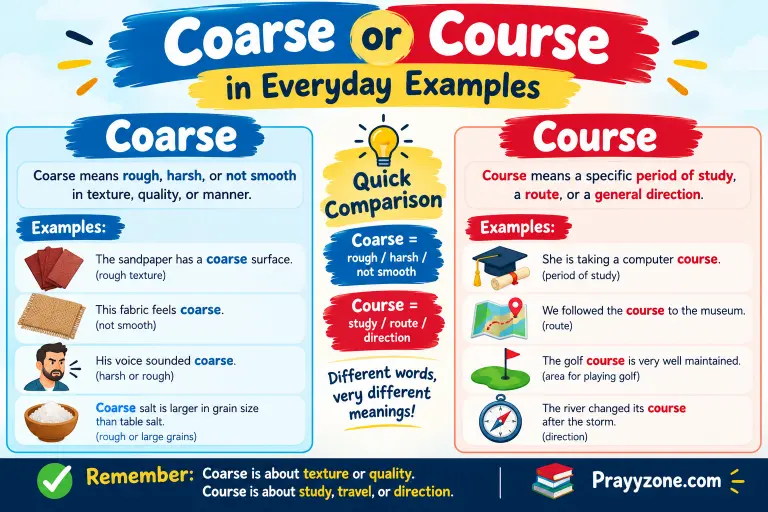
In emails
Course:
I am writing to ask about the photography course starting next month.
Coarse:
Please note that the material has a coarse texture.
In news writing
Course:
The government changed its economic course after the report.
Coarse:
The machine separates fine particles from coarse material.
On social media
Course:
Just finished my first online coding course!
Coarse:
This salt is much more coarse than the table salt.
In formal writing
Course:
The study examines the course of economic development.
Coarse:
The process removes coarse particles from the sample.
In every case, context tells you which spelling is correct.
Coarse or Course – Google Trends & Usage Data
Google Trends can help show how people search for words over time and across regions. However, Trends data should be read as relative search interest, not as a dictionary count or a direct measure of how often people use a word in everyday speech. Google provides tools for comparing search interest by location, time, and topic.
For coarse or course, search interest can be influenced by different meanings. The word course has many common uses, including education, travel, sports, meals, and general progress. Coarse has a narrower meaning and is often searched when people need help with spelling, vocabulary, or word choice.
Searches can also vary by country. English-speaking countries such as the United States, United Kingdom, Canada, Australia, and other regions may show different search patterns depending on education, local content, and context.
For content writers, the key point is simple: “coarse or course” is a word-choice query, while searches containing “course” alone often have completely different intent.
Coarse or Course Comparison Table
| Feature | Coarse | Course |
| Part of speech | Usually adjective | Usually noun; also verb |
| Pronunciation | Same as course | Same as coarse |
| Rough texture | ✅ | ❌ |
| Large particles | ✅ | ❌ |
| Rude or crude | ✅ | ❌ |
| Class or program | ❌ | ✅ |
| Route or direction | ❌ | ✅ |
| Process or progression | ❌ | ✅ |
| Part of a meal | ❌ | ✅ |
| Example | coarse sand | English course |
FAQs About Coarse or Course
1. Is it coarse or course?
Both spellings are correct. Coarse means rough, large-grained, crude, or unrefined. Course can mean a class, route, direction, process, or part of a meal.
2. Are coarse and course pronounced the same?
Yes. They are homophones in standard English, meaning they have the same pronunciation but different meanings and spellings.
3. Is it a coarse or a course?
It depends on the meaning.
- A course = a class or program.
- Coarse = rough or unrefined.
Example:
I joined a course.
The fabric is coarse.
4. What is an easy way to remember coarse?
Think of coarse as something rough. Coarse sand has large grains and a rough feel.
5. What is the meaning of course?
Course has several meanings. It can mean a class, route, direction, process, or part of a meal. It can also be a verb meaning to move or flow quickly.
6. Is “coarse language” correct?
Yes. Coarse language means rude, crude, or offensive language.
7. Is “English coarse” correct?
No, if you mean a class. The correct phrase is English course.
Conclusion: Coarse or Course
The difference between coarse or course is simple once you connect each word with its meaning. Coarse is an adjective. It describes something rough, made of large pieces, crude, or unrefined. You might talk about coarse sand, coarse fabric, or coarse language.
Course has several uses. It can mean a class, route, direction, process, or part of a meal. It can also work as a verb. You can take a course, change course, follow a course, or watch water course through a channel.
Both words sound alike, so it is easy to confuse them. However, their meanings are very different. Remember the simple rule: coarse means rough, while course means a class, route, or process.
There is also no important British-versus-American spelling difference. Both forms use coarse and course in the same way. When writing for school, work, websites, or international readers, focus on the meaning and choose the spelling that matches your sentence.