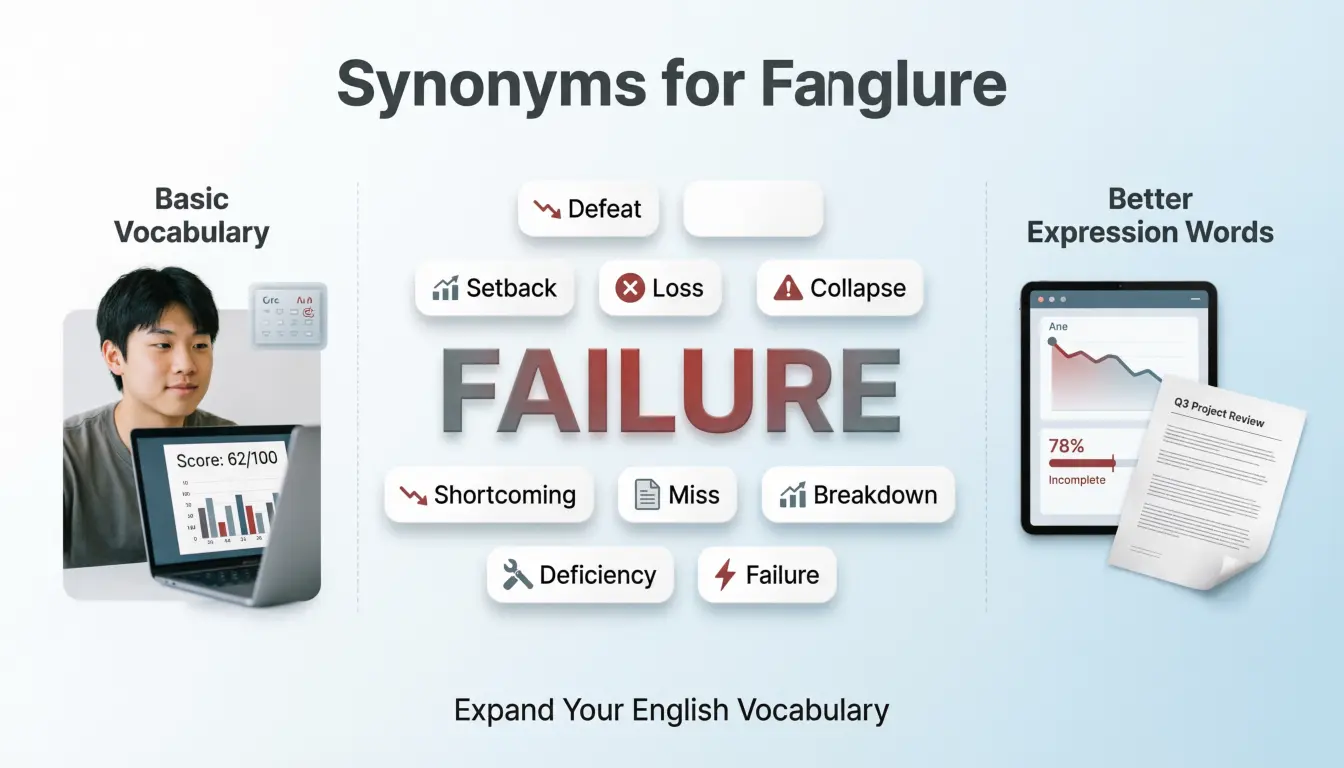
Have you ever tried something again and again but still did not get the result you wanted? Maybe a test, a job interview, or a business idea did not go as planned. That moment is often called failure. Many people search for synonyms for failure in English to express this feeling in different ways.
For example, a student may not pass an exam, or a business may lose money. Both situations can be described using different words for failure.
In simple English, failure means not getting success. It is when something does not work the way we hoped.
Learning synonyms for failure in English is very helpful for students, bloggers, content writers, and daily English users. It makes your writing richer, clearer, and more natural. It also helps you avoid repeating the same word again and again.
1. Failure
Meaning:
- When something does not succeed or work.
Examples:
- His project was a failure.
- She saw failure as a lesson.
2. Defeat
Meaning:
- When someone loses in a competition or fight.
Examples:
- The team faced defeat in the final match.
- He accepted defeat calmly.
3. Loss
Meaning:
- When you lose something important.
Examples:
- The company had a big loss.
- She felt the loss deeply.
4. Setback
Meaning:
- A small problem that slows progress.
Examples:
- Illness was a setback in his studies.
- The plan faced a setback.
5. Downfall
Meaning:
- A sudden fall from success.
Examples:
- Greed caused his downfall.
- The empire’s downfall shocked everyone.
6. Collapse
Meaning:
- When something breaks down completely.
Examples:
- The building’s collapse was tragic.
- The plan ended in collapse.
7. Flop
Meaning:
- A complete failure, often in shows or projects.
Examples:
- The movie was a flop.
- His idea turned into a flop.
8. Fiasco
Meaning:
- A very bad and confusing failure.
Examples:
- The event became a fiasco.
- The trip was a total fiasco.
9. Disaster
Meaning:
- A very bad situation or failure.
Examples:
- The party was a disaster.
- The project ended in disaster.
10. Mishap
Meaning:
- A small accident or mistake.
Examples:
- A small mishap delayed the work.
- The journey had a mishap.
11. Blunder
Meaning:
- A careless big mistake.
Examples:
- He made a blunder in the exam.
- The blunder cost them the game.
12. Error
Meaning:
- A wrong action or idea.
Examples:
- There was an error in the report.
- She corrected her error.
13. Fault
Meaning:
- A mistake or problem in something.
Examples:
- It was his fault.
- The fault caused system failure.
14. Shortcoming
Meaning:
- A weak point or lack in something.
Examples:
- His shortcoming is poor planning.
- Every person has some shortcomings.
15. Weakness
Meaning:
- A lack of strength or skill.
Examples:
- Time management is his weakness.
- Her weakness is math.
16. Imperfection
Meaning:
- Something not perfect.
Examples:
- Every design has imperfection.
- She accepted her imperfection.
17. Deficiency
Meaning:
- A lack of something needed.
Examples:
- Vitamin deficiency caused illness.
- The project has a skill deficiency.
18. Inadequacy
Meaning:
- Not enough quality or amount.
Examples:
- His inadequacy showed in results.
- She felt inadequacy in the role.
19. Letdown
Meaning:
- A situation that disappoints.
Examples:
- The ending was a letdown.
- The result was a big letdown.
20. Miss
Meaning:
- To fail to achieve something.
Examples:
- He missed the chance.
- She missed the target.
21. Rejection
Meaning:
- When something is not accepted.
Examples:
- His proposal got rejection.
- She faced rejection in interviews.
22. Non-success
Meaning:
- When success does not happen.
Examples:
- The plan was a non-success.
- It ended in non-success.
23. Ruin
Meaning:
- Complete destruction or loss.
Examples:
- The fire caused ruin.
- Bad decisions led to ruin.
24. Bankruptcy
Meaning:
- When a business has no money left.
Examples:
- The company faced bankruptcy.
- He declared bankruptcy.
25. Crash
Meaning:
- A sudden failure or stop.
Examples:
- The system crash stopped work.
- The market crash was serious.
26. Fall
Meaning:
- A drop in success or position.
Examples:
- His fall surprised everyone.
- The company saw a fall in sales.
27. Decline
Meaning:
- A slow decrease in success.
Examples:
- There is a decline in quality.
- Sales are in decline.
28. Drop
Meaning:
- A sudden decrease.
Examples:
- There was a drop in profit.
- The drop shocked investors.
29. Regression
Meaning:
- Going back to a worse state.
Examples:
- The patient showed regression.
- There is regression in progress.
30. Stall
Meaning:
- When progress stops.
Examples:
- The project hit a stall.
- Growth began to stall.
31. Halt
Meaning:
- A complete stop.
Examples:
- Work came to a halt.
- The plan was halted.
32. Dead end
Meaning:
- A situation with no result.
Examples:
- The idea was a dead end.
- The search reached a dead end.
33. Impasse
Meaning:
- A situation with no solution.
Examples:
- Talks reached an impasse.
- The deal is at an impasse.
34. Breakdown
Meaning:
- A failure in system or plan.
Examples:
- The machine breakdown caused delay.
- Communication breakdown led to issues.
35. Disappointment
Meaning:
- Feeling sad due to failure.
Examples:
- The result was disappointment.
- She felt deep disappointment.
36. Unsuccess
Meaning:
- Lack of success.
Examples:
- The attempt was unsuccess.
- It led to unsuccess in goals.
37. Misstep
Meaning:
- A small wrong action.
Examples:
- His misstep caused delay.
- One misstep ruined the plan.
38. Slip
Meaning:
- A small mistake.
Examples:
- A slip changed the result.
- He made a small slip.
39. Slip-up
Meaning:
- An unplanned mistake.
Examples:
- The slip-up caused loss.
- She admitted her slip-up.
40. Oversight
Meaning:
- A mistake from not noticing something.
Examples:
- It was an oversight in planning.
- The oversight caused delay.
41. Neglect
Meaning:
- Not giving attention.
Examples:
- Neglect caused system failure.
- His neglect led to loss.
42. Failure result
Meaning:
- The result of not succeeding.
Examples:
- It was a failure result.
- The test gave a failure result.
43. Poor outcome
Meaning:
- A bad final result.
Examples:
- The project had a poor outcome.
- Poor outcome disappointed everyone.
44. Negative outcome
Meaning:
- A harmful result.
Examples:
- The decision had a negative outcome.
- Negative outcome affected growth.
45. Adverse result
Meaning:
- A bad or harmful result.
Examples:
- The plan had an adverse result.
- Adverse result slowed progress.
46. Setback moment
Meaning:
- A moment of delay or problem.
Examples:
- It was a setback moment.
- The setback moment changed plans.
47. Loss of effort
Meaning:
- When effort gives no result.
Examples:
- It became a loss of effort.
- Loss of effort wasted time.
48. Wasted effort
Meaning:
- Effort that brings no success.
Examples:
- It was wasted effort.
- His work felt like wasted effort.
49. Failed attempt
Meaning:
- An attempt that did not succeed.
Examples:
- It was a failed attempt.
- Her failed attempt taught her.
50. Missed opportunity
Meaning:
- A chance that was not used.
Examples:
- It was a missed opportunity.
- He regretted the missed opportunity.
CONCLUSION
Learning synonyms for failure in English helps you speak and write in a clearer and more powerful way. These words improve your essays, blogs, emails, and daily conversations. They also help you express emotions and ideas more naturally. Practice using these words in real life, writing tasks, and speaking. The more you use them, the more confident your English becomes.